
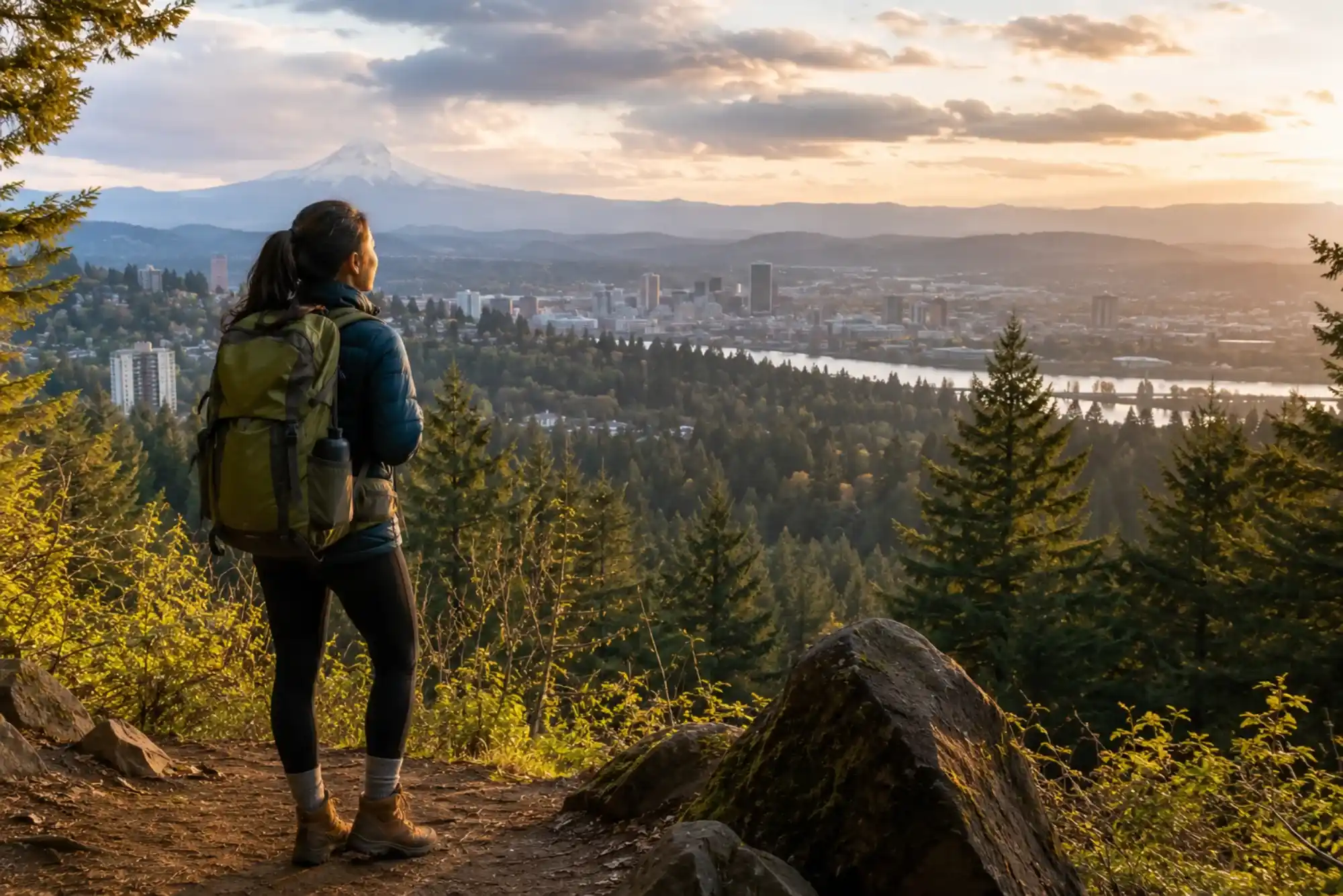
Portland sits at an unusual intersection of urban density and genuine wilderness. You can finish your morning coffee in a downtown café and be standing beneath a 200-foot waterfall before noon — no highway marathon required, no overnight gear, no permit lottery. Solo hiking in Portland has a particular quality that’s hard to explain until you’ve done it: the trails feel simultaneously accessible and remote, forgiving enough for beginners but varied enough that experienced hikers keep coming back for years without running out of new ground to cover.
What makes Portland exceptional for solo hikers specifically isn’t just the trail network — it’s the culture around it. This is a city where hiking is normalized as a weekday activity, where trailheads are served by transit, and where the outdoor community is large enough that you’ll rarely feel completely alone even when you’re hiking by yourself. That combination matters. It lowers the barrier to entry while still delivering the kind of solitude and scenery that make solo hiking worth doing in the first place.
Most American cities have parks. Portland has Forest Park, which is something categorically different. Stretching across more than 5,200 acres on the west hills above the city, it’s the largest urban forest in the United States — a continuous expanse of Douglas fir, western red cedar, and bigleaf maple that has no real equivalent in any other American metro area. Walking into Forest Park from a residential street, you cross an invisible line and the city simply disappears. Within ten minutes you’re in old-growth canopy, the understory thick with sword ferns, everything smelling like rain-soaked bark and moss.
The Wildwood Trail is the park’s main artery — a 30-mile continuous route that runs the full length of the park from south to north. No solo hiker needs to attempt it end-to-end on a single outing; most people pick a section between four and ten miles and turn back at a natural landmark. The southern sections near the Hoyt Arboretum are the most heavily trafficked, which actually works in a solo hiker’s favor — there are enough people on the trail that you’re never more than a few minutes from another human presence, but the crowds thin dramatically once you push north of the main access points.
The Pittock Mansion loop deserves particular mention because it delivers something unusual: a genuine dramatic payoff in a relatively compact package. The approach through the forest takes you through sections that feel genuinely remote, then deposits you at a 1914 French Renaissance estate perched above the city with views stretching to Mount Hood and Mount St. Helens on clear days. The contrast is jarring in the best possible way. The mansion grounds are free to walk; the interior charges admission if you want to explore inside. Most hikers are there for the view, which doesn’t cost anything.
Drive east from Portland for thirty minutes and the landscape shifts completely. The Columbia River Gorge begins where the Cascades meet the river — a massive canyon system with basalt cliffs on the Oregon side dropping straight to the water, and drier, more open hillsides on the Washington side. It’s one of the most visually dramatic landscapes in the Pacific Northwest, and its trail network is extensive enough that hikers spend entire seasons working through it without duplication.
Multnomah Falls is the obvious starting point for anyone new to Gorge hiking, and it earns its reputation. The 620-foot two-tier cascade is genuinely spectacular from the viewing bridge, but the real hike starts above it. Most visitors turn around at the bridge overlook; continue past it and climb the switchbacks, and the trail enters quieter forest with increasingly fewer people. The full push to Larch Mountain’s Sherrard Point summit — about 14 miles round trip with significant elevation — delivers panoramic views of five Cascade volcanic peaks on a clear day. It’s a full-day commitment for a solo hiker but one of the most rewarding in the region.
Angel’s Rest is a better option for those wanting a shorter but still substantial Gorge experience. The 4.7-mile out-and-back gains roughly 1,500 feet to a rocky open summit with wide river views. The trail was significantly rebuilt after the 2017 Eagle Creek Fire, and the restored route is in excellent condition — well-marked, well-maintained, and busy enough on weekends to feel comfortable for solo hikers while still delivering that characteristic Gorge atmosphere of dramatic vertical terrain compressed into relatively short distances.
Dog Mountain on the Washington side is the Gorge’s most demanding popular day hike — 7.1 miles with nearly 2,900 feet of climbing — but in late April and May, the summit meadows fill with balsamroot and lupine in a display that justifies every switchback. A permit system operates on weekends from late March through June, so check requirements before planning a spring visit. The descent is genuinely steep and demands attention; this is a solo hike best reserved for people with solid aerobic fitness and comfortable footing on sustained grades.
Solo hiking in Portland is safe, but it requires replacing the passive safety net of a group with your own deliberate habits. None of these are complicated or expensive. They’re just things that experienced solo hikers do consistently, and the consistency is what makes them effective.
The most important is also the simplest: tell someone your plan before you leave. Trailhead, route, expected return time, and what to do if they haven’t heard from you by a specific hour. This takes two minutes and matters more than any piece of gear you could buy. Trail conditions in Forest Park and the Gorge can change quickly — a turned ankle, a wrong junction, a weather shift — and having someone who knows where to direct search and rescue changes outcomes dramatically.
Navigation is the other thing worth taking seriously. Cell coverage is inconsistent in Forest Park and largely disappears in many Gorge trail corridors. Download your maps offline before leaving. AllTrails, Gaia GPS, and Caltopo all support offline caching, and any of them will serve you well. Forest Park’s junction network is complex enough that hikers relying solely on phone GPS can find themselves disoriented quickly; a physical backup map is worth carrying for any trail you haven’t done before.
Plenty of people researching Portland hiking before a visit find that curated weekend-specific guides are the most useful starting point — something that filters by distance and difficulty rather than listing every option in the region. Resources covering popular hikes in portland organized by achievability are genuinely helpful for matching trail choice to fitness level before committing to a route that turns out to be more demanding than anticipated.
The gear conversation in hiking can spiral quickly, but for Portland-area day hiking the essential list is shorter than most guides suggest. What matters is that you have it and know how to use it — not that it’s the most technical version available.
Footwear matters more than most gear. Portland’s trails are wet through much of the year, and cotton clothing loses its insulating properties entirely when damp, which creates real hypothermia risk on cool, wet days. Wool and synthetic fabrics are standard in the Pacific Northwest for good reason. Waterproof boots or trail runners for spring and fall; breathable trail runners in summer. The specific brand is less important than fit and break-in time before any ambitious outing.
Summer is the obvious peak season — trails are dry, high-elevation routes are fully accessible, and the long Pacific Northwest days give you generous light for full-day hikes. The practical consideration is timing. Popular Gorge trailheads fill by 8 AM on summer weekends. Getting on the trail by 7 eliminates both the parking problem and the densest crowds, and the morning light on the river from Gorge ridgelines is genuinely worth the early alarm.
Spring is its own distinct experience. Waterfalls run at maximum volume through March and April — Multnomah and its neighbors in the Gorge are at their most powerful during peak snowmelt. Trails at lower elevation are often muddy, and anything above 3,000 feet may carry snow through May. Carrying microspikes for higher routes in spring is worth the extra weight on uncertain-condition days.
Fall brings the bigleaf maple foliage to Forest Park and the lower Gorge, typically peaking through October. The light quality changes in autumn, the crowds thin after Labor Day, and the combination produces some of the best hiking conditions of the year. Rain returns progressively through October and into November; trails become slippery quickly after the first major storms, so checking conditions before setting out becomes more important than in summer.
Winter hiking in Portland is possible but calls for different expectations. Stick to lower-elevation, well-trafficked trails. Days are short — sunset before 4:30 PM in December — so early starts aren’t optional. Forest Park’s lower trail network handles winter well and sees enough foot traffic that solo hikers don’t feel isolated even on quiet weekdays.
The permit landscape for Portland-area hiking has expanded in recent years, particularly in the Columbia River Gorge where certain trailheads now require timed-entry permits during peak season. Dog Mountain on the Washington side requires a permit on weekends from late March through June — book in advance rather than assuming availability on the day. Several Oregon-side Gorge trailheads participate in similar programs. Always verify current requirements for your specific planned trail; the USDA Forest Service website and AllTrails community notes are both reliable sources for current information.
A Northwest Forest Pass or America the Beautiful pass is required at many Mount Hood National Forest trailheads. Day passes are available at trailhead kiosks for occasional visitors; annual passes make financial sense if you’re hiking the region regularly through a season. Oregon State Parks have their own fee structure, and Forest Park itself — managed by Portland Parks and Recreation — is free to access.
The Columbia Gorge Express shuttle runs seasonally from Gateway Transit Center to popular Gorge trailheads, including Multnomah Falls. For summer weekend hiking, taking the shuttle eliminates the parking problem entirely and removes one of the most frustrating logistics of peak-season Gorge hiking. The service is worth factoring into planning even if you have a car.
There’s something specific that solo hiking offers that group hiking doesn’t — a quality of attention that emerges when you’re not negotiating pace or conversation with anyone else. You stop when you want to stop. You spend twenty minutes at a creek crossing watching the water without feeling like you’re inconveniencing someone. Your actual pace — not a social average — becomes the pace, and discovering what that is turns out to be its own kind of information about yourself.
Portland’s trail culture makes this easier than most cities because hiking here is normalized to the point of being unremarkable. People hike before work, between meetings, on lunch breaks in Forest Park. The community around it is large and genuinely welcoming, the infrastructure is good, and the range of available terrain means you can calibrate each outing to exactly the kind of experience you want on any given day — a meditative forest walk, a demanding physical challenge, or something in between.
For those planning to explore the Pacific Northwest more broadly — extending beyond Portland into the surrounding region — the travel and outdoor resources available through hikes in portland offer well-organized guidance on building multi-destination hiking itineraries across Oregon and Washington that complement the city-specific trail network described here.
The trails are here. The city has done an unusual job of making them genuinely accessible, and the surrounding landscape has done the rest. What solo hiking in Portland requires, ultimately, is simply the decision to go — everything else tends to work itself out on the trail.
Related Reading: Travel Tutor Programs That Combine Adventure and Education
Related Reading: Best Way to Recharge Hafilat Card — full guide