Keeping aquarium water safe is one of the most important responsibilities of any fish keeper. Among the different water quality problems that can develop, ammonia is one of the most dangerous because it can quickly affect fish health, damage delicate gills, and even cause sudden losses in severe cases. Understanding how to lower ammonia in fish tanks naturally and quickly can help you respond before a small water-quality issue becomes a serious emergency.
Ammonia usually appears when fish waste, uneaten food, decaying plants, or other organic material breaks down inside the aquarium. In a healthy and properly cycled tank, beneficial bacteria convert ammonia into less harmful compounds. However, overfeeding, overcrowding, poor filtration, a disrupted nitrogen cycle, or inadequate maintenance can cause ammonia levels to rise.
The good news is that learning how to lower ammonia in fish tanks does not always require complicated treatments. With the right combination of water changes, improved filtration, reduced waste, and proper aquarium maintenance, you can often bring conditions back under control while protecting your fish. Reliable Water Chemistry Care can also help aquarium owners understand the importance of maintaining stable water conditions rather than reacting only after problems appear.
Before focusing on how to lower ammonia in fish tanks, it is important to understand where ammonia comes from. Ammonia is a natural by-product of biological waste. Fish release waste directly into the water, while leftover food, dead plant material, and other organic debris also produce ammonia as they decompose.
A properly established aquarium contains beneficial bacteria that form part of the nitrogen cycle. These bacteria process ammonia and convert it first into nitrite and eventually into nitrate. Nitrate is generally less toxic at controlled levels and can be managed through regular water changes and plant growth.
Problems often develop when the amount of waste entering the aquarium is greater than the biological filtration system can process. This commonly happens after adding too many fish, increasing feeding, cleaning the filter incorrectly, or setting up a new aquarium before the nitrogen cycle is fully established.
Overfeeding is one of the most common causes of ammonia spikes. Food that is not eaten does not simply disappear. It breaks down and contributes to organic waste inside the tank.
Fish should receive an amount of food they can comfortably consume without leaving significant leftovers behind. If food regularly settles on the substrate or becomes trapped around decorations, ammonia problems can develop over time.
Every fish adds biological waste to the aquarium. A tank with too many fish may produce more ammonia than the filter and beneficial bacteria can safely process.
This is why stocking decisions should consider more than the physical space available. Fish size, adult growth, behaviour, waste production, filtration capacity, and compatibility all affect the biological load of an aquarium.
New tanks are particularly vulnerable because beneficial bacteria colonies take time to establish. This is often called “new tank syndrome.”
Without a mature biological filter, ammonia can rise quickly. Learning how to lower ammonia in fish tanks is especially important for beginners because new aquarium problems can progress rapidly if water quality is not monitored.
When ammonia is detected, the priority is reducing the concentration while addressing the underlying cause. Quick action should be balanced with stability because sudden, extreme changes in water temperature or chemistry can also stress fish.
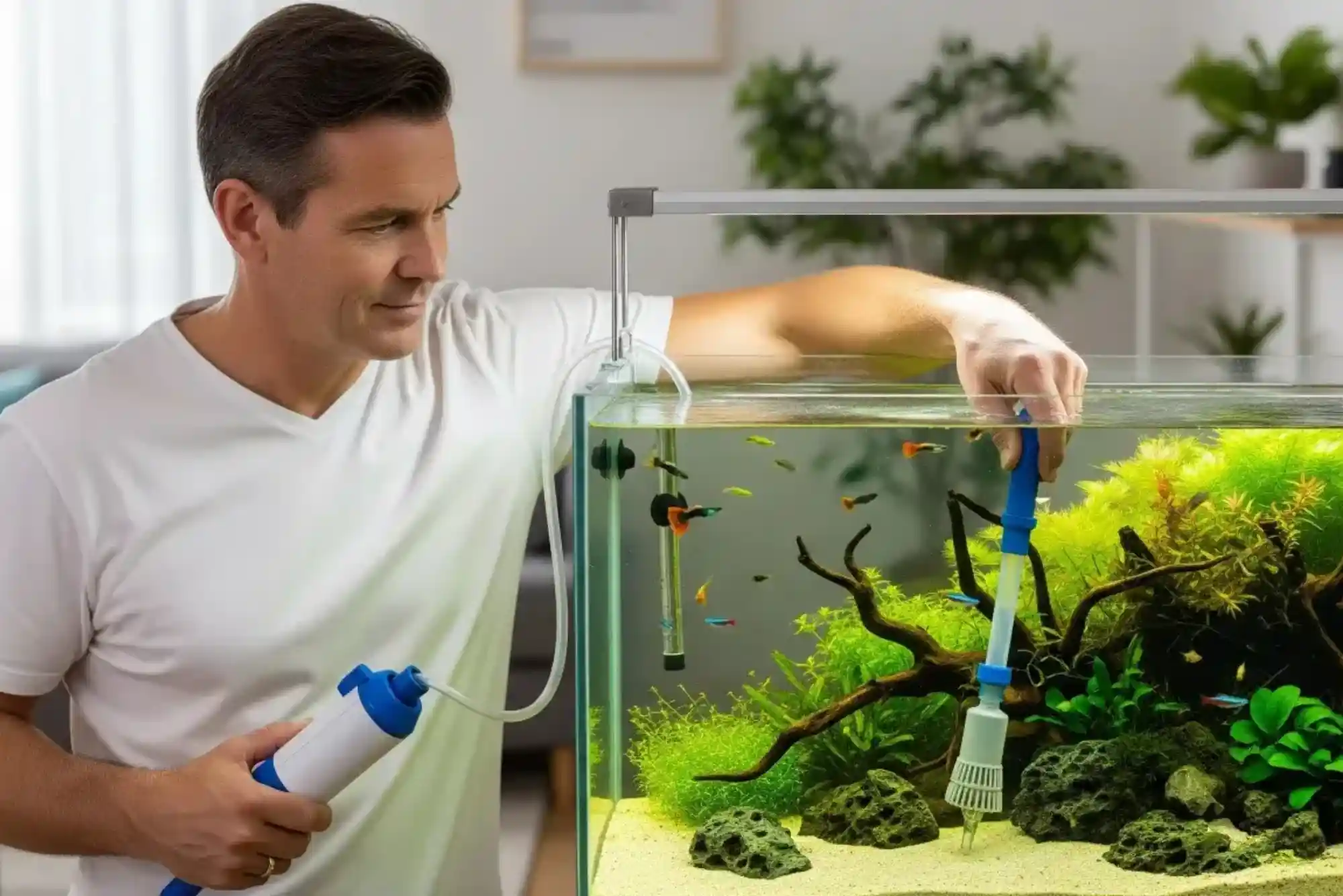
A partial water change is one of the fastest and most reliable ways to dilute ammonia. Replacing a portion of contaminated aquarium water with properly conditioned water immediately reduces the concentration of ammonia.
The replacement water should be treated to remove chlorine or chloramine and should be reasonably close to the aquarium’s temperature and general water conditions. Large differences can create additional stress for fish.
Depending on the severity of the ammonia level, repeated partial water changes may be necessary. Testing the water between changes helps determine whether ammonia is falling and whether the aquarium is beginning to stabilise.
For anyone researching how to lower ammonia in fish tanks, regular partial water changes should be viewed as an emergency response as well as an essential part of long-term aquarium maintenance.
Anything decomposing inside the aquarium can contribute to ammonia production. Carefully remove visible leftover food, dead plant leaves, deceased animals, and excessive debris.
Cleaning the substrate with an aquarium gravel vacuum can also help remove accumulated organic material. However, avoid unnecessarily disturbing every part of the aquarium at once, especially in an established tank where beneficial bacteria may be present on surfaces and inside filter media.
If ammonia is elevated, reducing the amount of food entering the aquarium can slow additional waste production. Healthy fish can generally tolerate a short reduction in feeding better than they can tolerate continuously worsening water quality.
The goal is not to starve fish for extended periods. Instead, temporarily limiting feeding gives the biological filtration system an opportunity to catch up while ammonia levels are being managed.
Natural ammonia control focuses on supporting the aquarium’s biological processes instead of relying entirely on chemical solutions. The strongest long-term defence against ammonia is a healthy, mature biological filter.
Beneficial bacteria are essential to the nitrogen cycle. They live primarily on surfaces such as filter media, substrate, decorations, and other areas within the aquarium.
One common mistake is replacing all filter media at the same time or aggressively washing it under untreated tap water. This can damage or remove important bacterial colonies and reduce the filter’s ability to process ammonia.
When cleaning filter media, gently rinsing it in removed aquarium water can help preserve beneficial bacteria while removing excessive debris. Only replace media when it is genuinely deteriorating or when replacement is necessary.
This simple habit is a crucial part of understanding how to lower ammonia in fish tanks without repeatedly disrupting the biological balance.
Live plants can support water quality by absorbing nutrients from the aquarium. Fast-growing aquatic plants may help reduce the accumulation of nitrogen compounds when maintained properly.
Plants should not be treated as a replacement for water changes or proper filtration, but they can become a valuable part of a balanced aquarium system. Healthy plant growth, appropriate lighting, and proper care can contribute to a more stable environment.
The suitability of a plant depends on the aquarium’s lighting, fish species, water conditions, and maintenance routine.
Good water circulation helps move waste toward the filtration system and supports an oxygen-rich environment for fish and beneficial bacteria.
Check whether the filter is functioning properly and whether water flow has become restricted by debris. In some aquariums, gentle additional aeration may also improve gas exchange and circulation.
Good circulation does not directly remove ammonia by itself, but it supports the biological processes responsible for processing waste.
A filter that appears to be running is not always filtering efficiently. Reduced flow, blocked intake areas, excessive debris, or unsuitable filter media can limit performance.
When dealing with elevated ammonia, inspect the filter carefully. Make sure water is flowing correctly and that the biological media has not been removed or damaged unnecessarily.
Mechanical filter media captures particles, while biological media provides surface area for beneficial bacteria. Both functions are important, but biological filtration plays a particularly important role when considering how to lower ammonia in fish tanks naturally over the long term.
Avoid replacing every piece of filter media simultaneously. Preserving an established bacterial colony can prevent the aquarium from experiencing another ammonia spike after cleaning.
You cannot reliably identify ammonia simply by looking at aquarium water. A tank can appear clean while containing dangerous levels of ammonia.
Regular water testing helps you monitor ammonia, nitrite, nitrate, and other important parameters. This is especially important in newly established aquariums, heavily stocked tanks, or any aquarium showing signs of stress.
If fish are gasping near the surface, breathing rapidly, becoming unusually inactive, showing red or irritated gills, or behaving abnormally, water testing should be one of the first steps.
These symptoms may be associated with poor water quality, including Ammonia Poisoning in Fish, although similar signs can also occur with other aquarium problems. Testing provides a clearer picture of what is happening inside the tank.
Understanding how to lower ammonia in fish tanks also requires understanding that ammonia toxicity is influenced by water conditions.
Ammonia exists in different chemical forms in aquarium water. Higher pH and higher temperatures can increase the proportion of the more toxic form of ammonia. This means the same total ammonia reading may present different levels of risk under different water conditions.
For this reason, avoid making sudden pH or temperature adjustments simply to address ammonia unless you understand the needs of your fish and the likely consequences. Stability is usually safer than dramatic corrections.
The best approach is to reduce the ammonia source, dilute elevated concentrations through appropriate water changes, and restore effective biological filtration.
Some aquarium water conditioners are designed to temporarily detoxify or bind certain forms of ammonia. These products may be useful during an emergency, particularly while water changes and biological filtration are working to restore safe conditions.
However, they should not be viewed as a permanent solution. If ammonia continues to be produced faster than the aquarium can process it, the underlying problem remains.
The most effective strategy for how to lower ammonia in fish tanks combines immediate water-quality management with long-term improvements in feeding, stocking, filtration, and maintenance.
Always follow the manufacturer’s instructions when using any water treatment product, and continue testing the aquarium rather than assuming the problem has been permanently solved.
The best way to manage ammonia is to prevent it from building up in the first place. A stable aquarium depends on a balance between the amount of waste produced and the system’s ability to process it.
Feed fish appropriately, avoid adding too many fish too quickly, maintain the filter without destroying beneficial bacteria, and perform consistent partial water changes. New fish should also be introduced gradually rather than suddenly increasing the aquarium’s biological load.
When setting up a new tank, allow the nitrogen cycle to establish before fully stocking the aquarium. Monitoring ammonia and nitrite during this period can help you understand when the biological filter is developing.
For aquarium owners looking for fish care guidance and water-related resources, Unitedfish provides a useful starting point for exploring aquarium care and maintaining healthier aquatic environments.
One mistake is performing an extreme cleaning session that removes beneficial bacteria along with visible waste. Scrubbing every surface, replacing all filter media, and completely changing the water can destabilise the aquarium.
Another common mistake is continuing normal or excessive feeding while ammonia is elevated. Adding more organic waste can make the problem worse.
Ignoring water tests is also risky. Aquarium conditions can change before obvious symptoms appear, and testing provides the information needed to respond appropriately.
Finally, repeatedly adding chemical products without addressing overfeeding, overcrowding, or filtration problems may create a cycle of temporary improvements followed by recurring ammonia spikes.
Learning how to lower ammonia in fish tanks effectively means treating both the current ammonia level and the reason it increased.
Any measurable ammonia can be a concern, particularly in a stocked aquarium, because fish sensitivity varies by species and water conditions.
A sudden rise accompanied by distressed fish requires prompt attention. Rapid breathing, gasping, unusual swimming, lethargy, and visible gill irritation can indicate a serious water-quality problem.
Start by confirming the reading with a reliable test, performing an appropriate partial water change, removing decomposing material, reducing feeding, and checking filtration.
If ammonia remains elevated despite corrective action, investigate whether the biological filter has been disrupted, whether the aquarium is overstocked, or whether an ongoing source of contamination or decomposition is present.
Knowing how to lower ammonia in fish tanks naturally and quickly is an essential skill for every aquarium owner. The immediate goal is to reduce harmful ammonia through appropriate water changes and waste removal, while the long-term goal is to create a stable biological system that can process fish waste efficiently.
Healthy aquarium care is based on consistency rather than quick fixes. Avoid overfeeding, protect beneficial bacteria, maintain effective filtration, monitor water parameters, and respond early when something changes.
If you want to build a healthier and more stable aquarium, start by checking your water quality today and reviewing your feeding, filtration, and maintenance routine. Explore reliable fish care resources and take a proactive approach to keeping your aquarium clean, balanced, and safe for the fish that depend on it.
The fastest approach is usually an appropriate partial water change using properly conditioned water, followed by removing uneaten food and decaying material. Check the filter, reduce feeding temporarily, and test the water regularly to monitor whether ammonia levels are improving.
You can lower ammonia naturally by supporting beneficial bacteria, maintaining effective biological filtration, avoiding overfeeding, removing organic waste, performing regular partial water changes, and using suitable live plants as part of a balanced aquarium system.
A healthy biological filter is the main long-term system that processes ammonia. Partial water changes dilute ammonia, while removing uneaten food and decaying waste reduces the amount of new ammonia entering the water.
Yes, a partial water change reduces the concentration of ammonia by replacing contaminated water with properly conditioned fresh water. However, the source of the ammonia must also be addressed to prevent levels from rising again.
The answer depends on the cause of the problem, the size of the aquarium, the amount of ammonia present, and the condition of the biological filter. Water changes can reduce ammonia immediately through dilution, while restoring a stable nitrogen cycle may take longer.
Some fish may recover when the water-quality problem is corrected quickly, but severe or prolonged ammonia exposure can cause serious damage and may be fatal. Early testing and prompt action give fish the best chance of recovery.
Related Reading: Understanding the Nitrogen Cycle: Ammonia, Nitrites, and Nitrates