
If you have ever stood in front of an aquarium shop trying to tell two tiny red-and-blue fish apart, you are not alone. The Neon Tetra vs Cardinal Tetra comparison is one of the most common questions among freshwater aquarium keepers. At first glance, both fish look almost identical. They have shimmering blue stripes, bright red coloration, peaceful personalities, and a natural tendency to move together in groups.
However, they are two different species with noticeable differences in appearance, size, temperature preferences, natural habitat, and aquarium requirements. The Neon Tetra is Paracheirodon innesi, while the Cardinal Tetra is Paracheirodon axelrodi. FishBase records both as members of the same genus, but their natural distributions and environmental preferences differ.
Understanding the differences matters because a beautiful school of tetras depends on more than simply buying colorful fish. Stable water, appropriate tank space, proper numbers, suitable tank mates, and consistent feeding all influence how confidently these fish behave.
This guide explains the Neon Tetra vs Cardinal Tetra differences in detail and shows how to create an aquarium where either species can thrive.
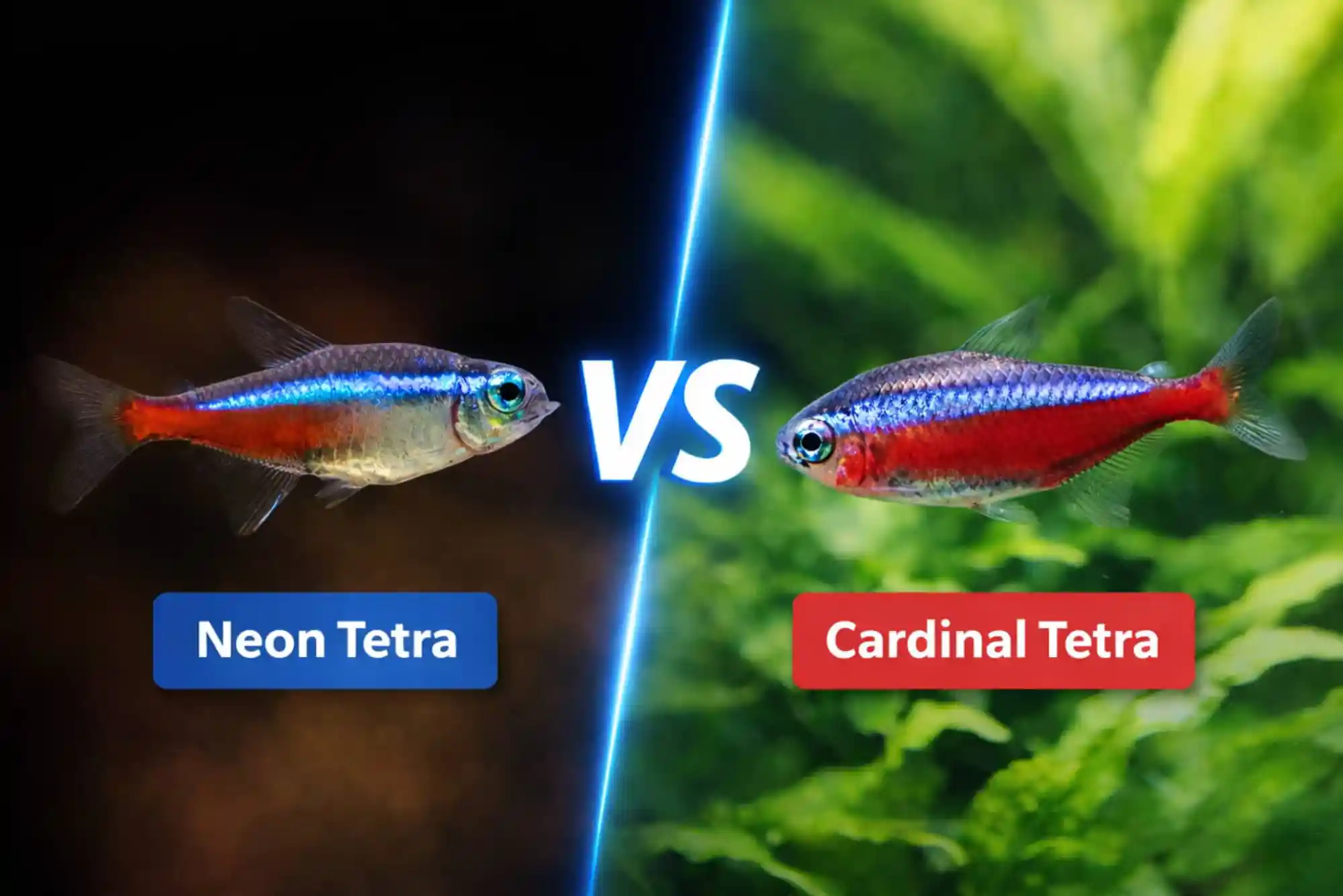
The easiest way to distinguish these fish is to look at the red stripe.
A Neon Tetra has an iridescent blue stripe running along its upper body, while the red stripe begins around the middle of the body and continues toward the tail. In a Cardinal Tetra, the red stripe extends almost the entire length of the body, from the head area toward the tail. This makes the Cardinal appear more heavily red when viewed from the side.
There is also a modest difference in size. Seriously Fish lists adult Neon Tetras at around 30 mm standard length, while Cardinal Tetras can reach approximately 35 mm. FishBase records similar maximum sizes for the two species.
The distinction becomes particularly obvious when both species are swimming together under aquarium lighting. Neons tend to have a more separated red-and-blue appearance, whereas Cardinals display a continuous red band beneath the blue stripe.
Neon Tetras are small, slender freshwater fish famous for their reflective blue stripe and bright red rear body. Their compact size makes them especially attractive for planted community aquariums.
The red coloration does not cover the entire underside. Instead, it begins farther back along the body. This is the easiest visual clue when identifying a Neon Tetra.
FishBase lists Paracheirodon innesi at a maximum recorded size of roughly 2.5 cm standard length, while aquarium references commonly place adults around 3 cm.
Cardinal Tetras have a similar blue stripe but a much more extensive red stripe. The red coloration runs along virtually the entire lower side of the fish, giving the species its particularly vivid appearance.
They are also slightly larger than Neon Tetras. Seriously Fish lists a standard length of about 35 mm.
This difference is small, but it can become noticeable in a large school. Cardinals often create a stronger red visual effect, particularly against dark substrate, driftwood, and subdued aquarium lighting.
Water stability is more important than chasing a perfect number.
Seriously Fish gives Neon Tetras a temperature range of approximately 21–25°C, with pH ranging from 4.0 to 7.5 and hardness from 1–12 dGH. Cardinal Tetras are listed at approximately 23–29°C, with a pH range of 3.5–7.5 and hardness of 1–12 dGH.
These broad published ranges should not be interpreted as an invitation to move fish between extreme conditions. Aquarium fish generally benefit from consistency. Sudden temperature changes or deteriorating water quality can cause considerably more trouble than maintaining a stable value that is slightly different from the conditions in their native habitat.
For a mixed aquarium, a stable temperature around the mid-20s Celsius can work well when the fish are properly acclimated and water quality is maintained.
Cardinal Tetras are associated with blackwater and clearwater environments in the upper Orinoco and Rio Negro regions. Their natural waters can be soft and acidic, particularly in blackwater habitats.
Both species should be introduced into a properly cycled aquarium rather than a newly established tank.
This point is sometimes overlooked because tetras are small and commonly marketed as beginner fish. Their size does not mean they can tolerate unstable water.
Cardinal Tetras, particularly wild specimens, deserve careful acclimation because wild-caught fish can be less tolerant of deteriorating aquarium conditions. Seriously Fish specifically notes this consideration for Cardinal Tetras.
Neon Tetras available through the aquarium trade are commonly commercially produced, and Seriously Fish notes that many are more adaptable than wild specimens.
Instead of asking which species is universally easier, look at the condition of your aquarium. A mature, biologically stable tank with consistent maintenance provides a much better foundation for either species.
Neon Tetras are schooling fish, so keeping one or two individuals is not appropriate for normal long-term care.
FishBase recommends keeping Neon Tetras in groups of at least five, while many modern aquarium keepers prefer larger groups because they display more natural social behavior when given adequate space.
A group of eight or more can produce a much more impressive visual effect than a tiny group. In a suitably sized aquarium, increasing the school allows the fish to move more naturally through open swimming areas.
The important thing is to balance the number of fish with aquarium volume, filtration, swimming space, and the rest of your stocking plan.
Cardinal Tetras also benefit from being kept in a proper shoal. FishBase recommends groups of at least five, while experienced aquarists commonly choose larger groups for stronger schooling behavior.
A larger group can help the fish appear more confident. Instead of hiding individually, they are more likely to move through the middle areas of the aquarium together.
For a display-focused aquarium, a group of 10 or more can create an impressive schooling effect if the tank is large enough to support them comfortably.
Rather than treating six fish as a magic number, consider it a starting point. More space allows you to maintain a larger group without forcing the aquarium into an overcrowded condition.
Dense plants are excellent for tetras, but the entire aquarium should not be packed with vegetation.
Leave an open central or front swimming area where the school can move continuously. Plants around the sides and rear provide security while open water allows the fish to display their natural movement.
Both species look particularly attractive in planted aquariums.
Cardinal Tetras naturally occur in environments influenced by vegetation, branches, and leaf litter. Seriously Fish recommends natural-style aquariums using features such as sandy substrate, driftwood, aquatic plants, and subdued lighting.
Neon Tetras can also look excellent in planted setups with floating vegetation and shaded areas.
The goal is not to create a completely dark aquarium. Instead, combine shaded areas with enough open water for schooling.
Small tetras are peaceful community fish, but that does not mean every community fish is appropriate.
Avoid large predatory species that can swallow them or highly aggressive fish that constantly chase them. Peaceful small community species are generally a safer match.
Seriously Fish describes both Neon and Cardinal Tetras as peaceful shoaling species suitable for community aquariums when compatible tank mates are selected.
Tetras need oxygenated water, but extremely strong currents can make a small school work unnecessarily hard.
Aim for circulation that keeps the aquarium well oxygenated while still leaving calmer areas where the fish can rest and move naturally.
Yes, Neon Tetras and Cardinal Tetras can generally be kept together in a peaceful community aquarium when their environmental needs are compatible.
Both belong to Paracheirodon and have similar peaceful behavior. Their care requirements overlap enough that many aquarists successfully maintain them in the same aquarium. Aquarium Co-Op also describes the two species as having similar care requirements.
However, there is an important consideration: mixing two schooling species means you need enough room and enough fish to support both groups properly.
A small aquarium should not be stocked heavily simply because both species are small. If you want a mixed display, plan the aquarium around the adult size and behavior of the entire community.
In larger planted aquariums, their red-and-blue coloration can create a beautiful layered schooling effect.
Neither species requires an exotic diet.
Both are omnivorous and naturally consume small aquatic organisms and plant material. In an aquarium, quality micro-pellets or appropriately sized flakes can form the foundation of their diet, while small frozen or live foods can provide variety. Seriously Fish recommends foods such as Daphnia, bloodworm larvae, and other small aquatic foods for Cardinal Tetras.
The key is particle size. A food can be nutritionally excellent but still unsuitable if the fish cannot comfortably consume it.
Feed small portions and observe the school. If food remains on the substrate after feeding, reduce the amount next time.
Variety is useful, but consistency matters even more. Regular feeding combined with good water quality generally produces better long-term results than constantly changing foods.
A 60 cm aquarium is a useful minimum reference for a proper school, with FishBase listing a minimum aquarium length of 60 cm for both species.
For practical fishkeeping, a larger aquarium can be considerably easier to manage because additional water volume provides more swimming space and greater stability.
A planted aquarium with dark substrate, driftwood, floating plants, and moderate lighting can showcase both species beautifully.
Cardinals are particularly striking in blackwater-inspired aquariums. Tannins, subdued lighting, and natural materials can create an environment that visually complements their strong red coloration.
You do not need to recreate the Amazon perfectly, however. A stable, well-maintained community aquarium can also be an excellent home.
The answer depends on the aquarium you are building rather than on a universal winner.
Neon Tetras are smaller and have a shorter red stripe, while Cardinal Tetras are slightly larger and have a full-length red stripe. Their temperature preferences overlap, although Cardinals are associated with warmer conditions.
If you want the classic red-and-blue tetra appearance in a community aquarium, either species can work beautifully when its environmental needs are met.
If you are designing a warmer, heavily planted aquarium with soft water and a dramatic red-and-blue school, Cardinals can be especially attractive. If you prefer the classic smaller tetra and have an established community setup, Neons are a familiar option.
The most important decision is not simply the species name. It is whether your aquarium can consistently provide appropriate water quality, adequate space, a proper social group, and compatible tank mates.
One common mistake is buying only two or three tetras because they are small. Their schooling behavior is one of the reasons people keep these fish, so group size should be considered before purchasing.
Another mistake is adding them to an immature aquarium. A tank that looks clean may still lack the biological stability required to process fish waste safely.
Overfeeding is another frequent problem. Tiny fish require tiny meals, and excess food quickly contributes to water-quality problems.
Finally, avoid constantly changing water parameters in an attempt to reach a particular “perfect” number. Stability is a fundamental part of successful tetra care.
The Neon Tetra vs Cardinal Tetra comparison becomes much easier once you know what to look for. Neons have a shorter red stripe and slightly smaller adult size, while Cardinals have a red stripe that extends almost the entire length of the body and grow somewhat larger. Both are peaceful shoaling fish that can become spectacular aquarium residents when kept in appropriate groups.
The best results come from a mature aquarium, stable water conditions, sensible stocking, appropriate food, and peaceful companions. Give the school open swimming space while using plants and natural decorations to provide security.
Whether you choose Neon Tetras, Cardinal Tetras, or a carefully planned combination of both, focus on creating a stable environment rather than chasing a perfect set of numbers.
Ready to improve your tetra aquarium? Start by checking your tank’s temperature, water quality, filtration, swimming space, and current group size. Small improvements in these areas can make a noticeable difference in fish behavior, coloration, and long-term health.
Neither species is universally better. Cardinal and Neon Tetras have similar peaceful behavior but differ in appearance, adult size, and preferred temperature range. The right choice depends on your aquarium conditions and the type of setup you want to maintain.
Yes. They can generally live together in a peaceful, appropriately sized community aquarium. Their similar behavior and overlapping environmental requirements make them compatible when water conditions and stocking are managed properly.
At least five is a commonly cited minimum, with larger groups generally providing a more natural schooling display when the aquarium has enough space. FishBase specifically lists groups of five or more.
Cardinal Tetras are shoaling fish and should not be kept alone. FishBase recommends groups of five or more, while larger groups can provide a stronger schooling effect when aquarium space allows.
The Cardinal Tetra generally appears more extensively red because its red stripe extends along almost the entire body. The Neon Tetra has a shorter red stripe that begins farther back toward the middle of the body.
Their published temperature ranges differ. Seriously Fish lists Cardinals at approximately 23–29°C and Neons at approximately 21–25°C. Maintaining a stable temperature within the appropriate overlap is important when keeping both species together.
Neon Tetras are social shoaling fish and naturally remain in groups. Keeping an appropriate number together encourages more confident and natural behavior.
Related Reading: Understanding the Nitrogen Cycle: Ammonia, Nitrites, and Nitrates