Algae is one of the most common challenges faced by freshwater aquarium keepers. A small amount of algae is completely normal and can even contribute to a healthy aquarium ecosystem, but excessive growth can cover aquarium glass, plants, rocks, driftwood, and decorations. When algae begins to dominate the appearance of a tank, many aquarists look for natural ways to control it. This is where algae-eating aquarium inhabitants can become valuable members of a freshwater cleanup crew.
Among the many species available to aquarium keepers, snails, shrimp, plecos, and other grazing animals have become popular because they naturally forage across aquarium surfaces. Their feeding habits can help reduce certain types of algae while also removing leftover food and organic material. However, choosing the right algae eater requires more than simply picking the animal that looks most interesting. Tank size, water parameters, existing fish, available food, plant selection, and the particular type of algae all influence whether an algae eater will be successful.
This guide explores five of the most useful algae-eating choices for freshwater aquariums: nerite snails, Amano shrimp, cherry shrimp, bristlenose plecos, and Otocinclus catfish. Each has different strengths, care requirements, and limitations. Understanding those differences makes it easier to create a balanced aquarium rather than expecting one animal to solve every algae problem.
Before adding an algae eater, it is important to understand why algae appears in the first place. Algae requires light and nutrients to grow. Aquarium lighting, fish waste, uneaten food, decaying plant material, and nutrient accumulation can all contribute to increased algae growth.
A healthy aquarium does not necessarily need to be completely free of algae. In fact, many algae-eating animals depend on natural algae, biofilm, and microorganisms as part of their diet. The goal should therefore be controlled algae growth rather than attempting to create a sterile environment.
Different algae species also require different approaches. Soft green algae, diatoms, green spot algae, hair algae, and other forms can appear under different aquarium conditions. Some algae eaters are excellent at scraping hard surfaces, while others are better at picking through plants, substrate, and small spaces.
This is why an algae eater should be considered part of a broader aquarium maintenance strategy. Aquarium Co-Op notes that algae eaters do not completely replace other forms of algae control and should instead help reduce the amount of manual cleaning required.
For broader aquarium maintenance and filtration solutions, aquarists can also explore United Fish’s aquarium filtration resources, because effective filtration and responsible maintenance are important parts of maintaining stable water conditions.
The best algae eater is not necessarily the species that consumes the largest amount of algae. A suitable cleanup animal should fit naturally into the aquarium’s environment without creating additional problems.
Tank size is one of the most important considerations. Some plecos grow substantially larger than beginners expect, while small shrimp and snails can be suitable for nano aquariums. A species that outgrows the aquarium can eventually create waste-management problems and may require relocation.
Temperament also matters. A peaceful algae eater may be ideal for a community aquarium, while certain species can become unsuitable when housed with aggressive or predatory fish. Shrimp in particular can be vulnerable to larger fish.
Water chemistry should also be considered. Snails need adequate minerals for healthy shell development, while different fish species have their own preferred temperature, pH, hardness, and oxygen requirements. A successful algae-control strategy therefore starts with choosing an animal that matches the existing aquarium rather than forcing the aquarium to accommodate an unsuitable species.
Feeding is another frequently misunderstood issue. Algae eaters should not be expected to survive indefinitely on aquarium algae alone. Once algae levels decline, supplemental food may be necessary. Amano shrimp, for example, consume algae but also feed on biofilm, leftover food, vegetables, and other available organic material.
Nerite snails are among the most popular algae-eating inhabitants for freshwater aquariums. Their relatively small size makes them particularly useful in planted aquariums and smaller community setups. They move slowly across glass, rocks, plants, and decorations while scraping algae from hard surfaces.
One of their greatest advantages is their ability to consume stubborn green spot algae. Green spot algae can form hard green dots on aquarium glass and plant leaves, making it difficult to remove manually. Nerite snails are one of the few commonly kept aquarium animals known for grazing on this type of algae.
Nerite snails are also attractive animals. Depending on the variety, their shells can feature stripes, spots, ridges, or contrasting patterns. Zebra, tiger, horned, and other varieties are commonly appreciated not only for their cleaning abilities but also for their decorative appearance.
Another advantage is population control. Nerites can lay eggs in freshwater, but their larvae generally require brackish or saltwater conditions to develop successfully. As a result, they do not normally create the rapid population explosion associated with some other aquarium snails.
However, nerite snails still require appropriate care. They need sufficient minerals for healthy shell development, and very soft or mineral-deficient water can contribute to shell deterioration. They can also starve in an extremely clean aquarium where there is not enough natural food.
This means adding a nerite snail to an aquarium with no algae and expecting it to live entirely from the tank surfaces is not ideal. Supplemental foods may become necessary when natural algae becomes scarce.
Nerites work especially well when the aquarium has hard surfaces that regularly develop algae. They can complement regular glass cleaning and water maintenance rather than replacing those tasks.
Amano shrimp have earned a strong reputation among planted aquarium keepers because of their ability to graze continuously across small surfaces. Their scientific name is Caridina multidentata, and their relatively larger size compared with many dwarf shrimp gives them a useful advantage when dealing with algae and organic debris.
One of the biggest strengths of Amano shrimp is their ability to access places that larger animals cannot easily reach. Their small legs allow them to pick through plants, rocks, wood, substrate, and narrow spaces. This makes them useful for aquariums with complicated hardscape layouts.
Amano shrimp consume algae, biofilm, leftover food, decaying plant material, and other organic material. Their diet is therefore broader than simply algae.
They can be particularly helpful against certain forms of filamentous or fuzzy algae. However, their effectiveness depends partly on how much alternative food is available. If an aquarium provides abundant fish food, shrimp may naturally choose those easier food sources instead of spending as much time grazing algae.
This is an important principle when using any algae eater: an animal with unlimited access to rich supplemental food may have less motivation to consume algae.
Amano shrimp are also generally peaceful and can work well in community aquariums when kept with compatible tank mates. Larger predatory fish, however, can view shrimp as food. For this reason, aquarium inhabitants should always be considered before introducing shrimp.
Water quality and mineral availability also matter because shrimp must regularly molt. Stable conditions and appropriate mineral availability support healthy shell development and successful molting.
Amano shrimp are particularly useful in planted aquariums where algae can grow around leaves, wood, rocks, and other structures. Their small size and constant grazing behavior make them one of the most versatile cleanup-crew animals available to freshwater aquarists.
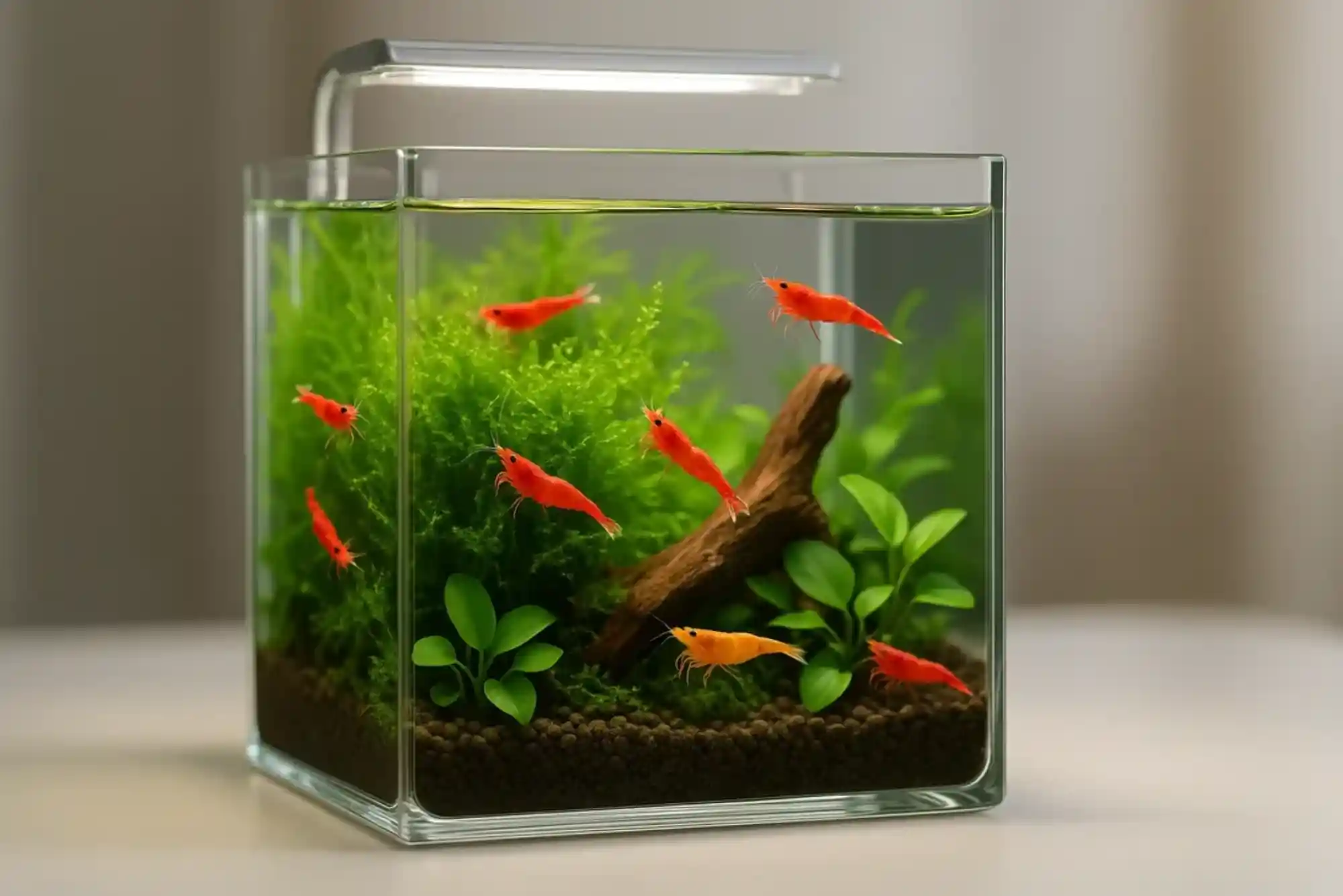
Cherry shrimp, commonly associated with Neocaridina davidi, are another popular freshwater aquarium cleanup animal. They are considerably smaller than bristlenose plecos and have a very different role in algae management.
A single cherry shrimp will not necessarily eliminate a major algae outbreak. Their real advantage comes from their ability to establish colonies in suitable aquariums. A growing group can continuously graze on biofilm, small algae patches, leftover food, and organic debris.
Their tiny size allows them to reach areas that larger algae eaters may ignore. They can climb across plant leaves, move through moss, explore substrate, and investigate narrow spaces between aquarium decorations.
Cherry shrimp are also popular because of their range of colors. Selective breeding has produced numerous color variations, making them both functional aquarium inhabitants and attractive additions to planted tanks.
Their peaceful nature makes them suitable for many community setups, but tank mates must be selected carefully. Larger fish may eat shrimp, especially newly hatched or juvenile shrimp. A shrimp-friendly aquarium usually provides plants, moss, rocks, wood, or other structures where shrimp can hide.
Unlike Amano shrimp, cherry shrimp can reproduce readily in freshwater when conditions are suitable. This can eventually create a substantial colony, although survival of young shrimp depends greatly on the aquarium environment and tank mates.
Cherry shrimp are best thought of as preventative algae-control helpers rather than emergency algae-removal machines. Their continuous grazing can help prevent small accumulations from becoming more noticeable problems.
Bristlenose plecos are often recommended to aquarists who want a larger algae-eating fish without choosing one of the very large common plecostomus species.
The term “pleco” can create confusion because many different species are sold under similar common names. Some plecos can grow far too large for typical home aquariums. Bristlenose plecos, belonging to the Ancistrus group, generally remain much smaller and are therefore more practical for appropriately sized community aquariums.
Their sucker-like mouth allows them to graze across aquarium surfaces. They can consume algae from glass, rocks, wood, and other hard surfaces while also scavenging for food.
Bristlenose plecos are especially interesting because their appearance changes with maturity. Adult males commonly develop prominent bristles around the snout, giving the fish its distinctive appearance.
Although bristlenose plecos are effective algae grazers, they should never be treated as animals that can survive entirely from algae growing in the aquarium. They need a balanced diet that can include appropriate sinking foods and vegetable matter. Aquarium Co-Op recommends providing foods such as sinking wafers and vegetables alongside other suitable foods to support their nutritional needs.
Their waste production also needs to be considered. A larger fish produces more waste than a small snail or shrimp, so the aquarium must have adequate filtration and maintenance practices.
Bristlenose plecos are therefore better suited to established, appropriately sized aquariums rather than tiny desktop tanks. They can become valuable members of a larger cleanup crew when their space, diet, and water-quality requirements are properly managed.
For aquarium owners looking at complete filtration and aquarium equipment solutions, United Fish provides aquarium-related resources that can help when planning a suitable aquatic setup.
Otocinclus catfish are small freshwater fish that have become particularly popular in planted aquariums. Their compact body allows them to move around plant leaves and other surfaces while grazing on algae and biofilm.
They are sometimes called dwarf suckermouth catfish because of their small size and sucker-like mouth. Compared with larger plecos, Otocinclus can work in much smaller aquariums when the aquarium itself is mature and properly maintained.
Their feeding behavior makes them particularly useful for surfaces covered with soft algae and natural biofilm. They often move across plant leaves, glass, and decorations while continuously grazing.
However, Otocinclus have an important care consideration: they can be prone to underfeeding. A newly established aquarium may not have enough natural algae or biofilm to support them. This is one reason mature planted aquariums can be better environments for these fish.
Supplemental foods may be required when natural food becomes limited. Vegetables and appropriate algae-based foods can help provide additional nutrition.
Otocinclus are also social fish. They generally feel more secure when kept with others of their kind rather than being maintained as solitary specimens. Their peaceful nature makes them compatible with many calm community aquarium species, but larger fish that could prey on them should be avoided.
Their small size, peaceful behavior, and ability to graze plant surfaces make them especially attractive for planted freshwater aquariums.
The best algae eater depends on the aquarium rather than on a universal ranking. A nano aquarium may benefit from nerite snails or a carefully planned shrimp colony, while a larger planted community aquarium may have enough space for bristlenose plecos or a suitable group of Otocinclus.
Aquarium Co-Op similarly recommends considering tank size when choosing algae eaters because some species can quickly outgrow an aquarium. Smaller systems can accommodate options such as Amano shrimp and nerite snails, while larger aquariums provide additional possibilities.
Water chemistry should also influence the decision. Nerite snails generally benefit from mineral-rich water, while shrimp need stable conditions that support successful molting. Fish species have their own temperature and water-chemistry preferences.
Tank mates are equally important. A shrimp may be an excellent algae eater in a peaceful planted aquarium but a poor choice in a tank containing fish large enough to consume it. Similarly, a slow-moving snail may struggle when housed with species that constantly harass or attack it.
The aquarium’s existing algae type is another major consideration. Nerite snails can be particularly useful for hard green spot algae, while shrimp are excellent at picking through small surfaces and biofilm. Bristlenose plecos provide a different grazing pattern, and Otocinclus are particularly suited to soft growth on plant and hardscape surfaces.
One of the most common aquarium mistakes is adding an algae eater without addressing the conditions causing excessive algae growth.
If lighting is excessive, nutrients are accumulating, fish are being overfed, or aquarium maintenance is inconsistent, an algae eater may only reduce the visible symptoms without solving the underlying issue.
Aquarium Co-Op explains that algae control works best when algae eaters are combined with other methods rather than being expected to do everything themselves.
A balanced aquarium usually requires appropriate lighting duration, sensible feeding, regular water changes, effective filtration, healthy plant growth, and removal of excess organic material. When these factors are managed properly, algae often becomes much easier to control.
It is also important to identify the algae correctly. Not every green-looking growth is something that a cleanup animal will consume. Blue-green algae, for example, is actually cyanobacteria rather than true algae, and typical algae eaters generally do not solve this type of problem.
This distinction prevents aquarists from repeatedly adding animals that cannot address the actual problem.
A successful aquarium does not need to be filled with algae eaters. In many cases, a carefully selected combination of species works better than adding large numbers of one animal.
For example, nerite snails can focus heavily on hard surfaces, Amano shrimp can explore plants and narrow spaces, and an appropriately sized bristlenose pleco can graze larger surfaces and driftwood. In another aquarium, a shrimp colony may be all that is necessary to provide continuous preventative maintenance.
The key is moderation.
Adding too many algae eaters can create another biological problem because every animal contributes waste to the aquarium. If the algae disappears, the animals still need food. This can lead to overfeeding, increased waste, and potentially another nutrient imbalance.
A good cleanup crew should therefore complement the aquarium’s biological system rather than overwhelm it.
An interesting problem can occur after successful algae control: there may no longer be enough natural food.
This is especially important with snails and algae-grazing fish. If an aquarium has been cleaned aggressively and algae growth has been reduced to almost nothing, animals that previously depended on natural grazing may struggle to find enough food.
Supplemental foods can help. Depending on the species, appropriate algae wafers, sinking foods, blanched vegetables, or other species-specific foods can provide additional nutrition.
Amano shrimp, for instance, are opportunistic scavengers and consume much more than algae. Their diet can include biofilm, vegetables, leftover fish food, and decaying organic material.
The goal should not be to starve algae eaters so they consume algae. Instead, feeding should be managed intelligently so animals receive proper nutrition while still having opportunities to graze naturally.
Algae management begins with maintaining a stable aquarium environment. Filtration helps process waste and maintain water quality, while regular maintenance removes accumulated organic material.
Excess nutrients can contribute to algae growth. Uneaten food, fish waste, and decaying leaves can provide nutrients that algae can use. Aquarium Co-Op notes that reducing excess organic material is an important part of controlling algae growth.
This means an algae eater should be viewed as one part of the aquarium system rather than as a replacement for filtration.
Good filtration, appropriate stocking, responsible feeding, water changes, and suitable lighting all contribute to a healthier environment. Once these fundamentals are established, algae-eating animals can provide an additional layer of natural maintenance.
Nerite snails, Amano shrimp, cherry shrimp, bristlenose plecos, and Otocinclus catfish can all play useful roles in freshwater aquariums, but they are not interchangeable.
Nerite snails are especially useful for hard surface algae and can be excellent choices for smaller aquariums. Amano shrimp are versatile grazers capable of reaching small spaces throughout planted tanks. Cherry shrimp provide continuous low-level grazing and can establish colonies in suitable peaceful aquariums. Bristlenose plecos offer a larger fish option for appropriately sized tanks, while Otocinclus catfish are excellent small grazers for mature planted environments.
The best choice depends on the aquarium’s size, water chemistry, existing livestock, plant layout, algae type, and available food.
Most importantly, no algae eater should be expected to completely eliminate algae. A healthy freshwater aquarium naturally contains microorganisms and some algae. The goal is to maintain that growth at a manageable level through balanced lighting, sensible feeding, effective filtration, routine maintenance, healthy plants, and appropriately selected cleanup animals.
When those elements work together, algae eaters become more than simple “tank cleaners.” They become part of the aquarium’s living ecosystem, helping keep surfaces active, reducing accumulated organic material, and adding interesting natural behavior to the freshwater environment.