
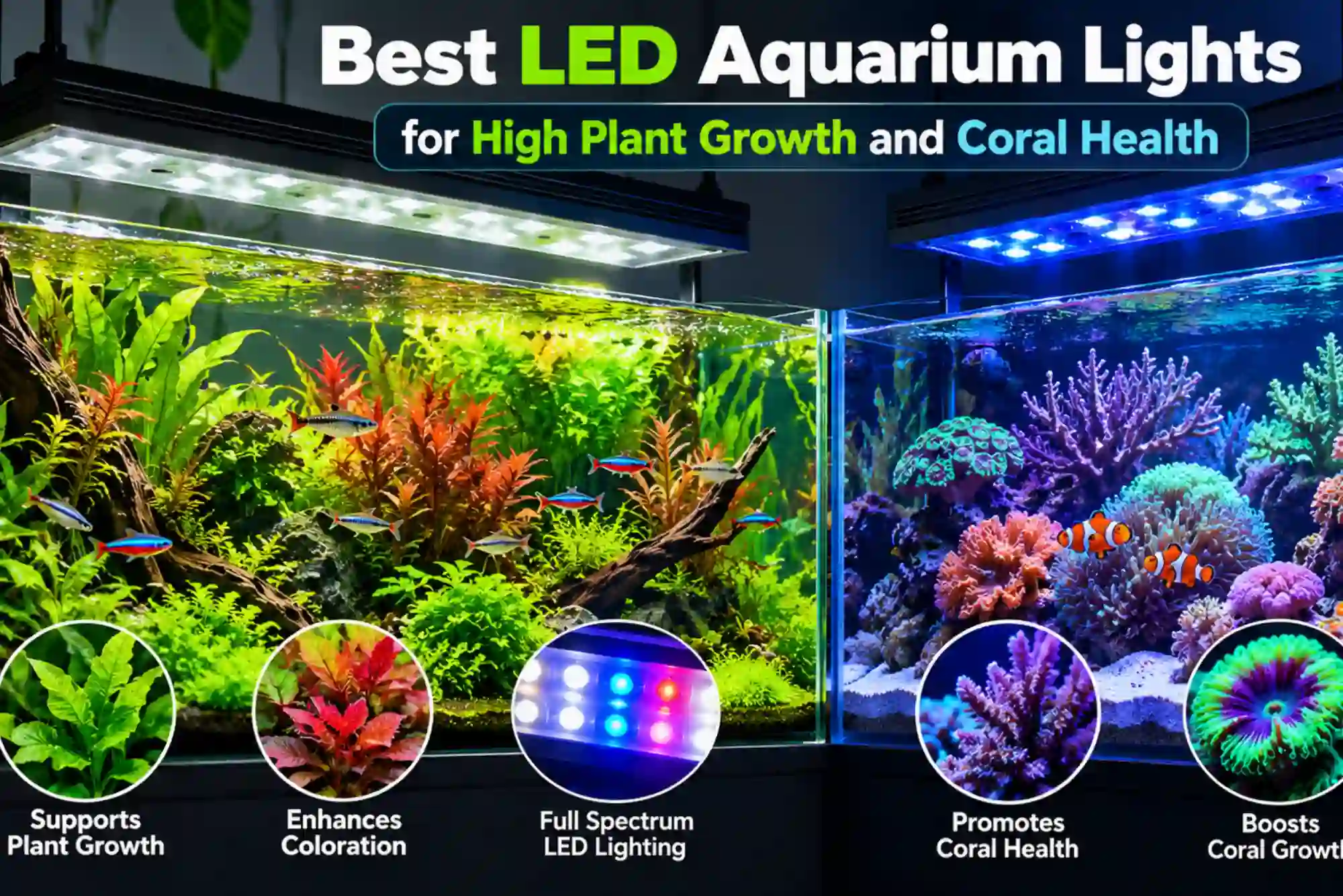
Aquarium lighting is much more than a way to make fish, plants, and corals look attractive. In a well-designed aquarium, lighting becomes one of the main factors influencing plant growth, coral health, coloration, photosynthesis, and the overall appearance of the aquatic environment. Choosing the best LED aquarium lights can therefore make a significant difference between a tank that merely survives and one that develops into a healthy, vibrant ecosystem.
Modern LED aquarium lights have become popular because they combine energy efficiency, adjustable intensity, controllable color channels, and long operating life in a relatively compact fixture. Unlike basic aquarium bulbs that simply illuminate the tank, quality LED systems can provide carefully controlled light suitable for freshwater plants and photosynthetic corals.
However, brighter does not automatically mean better. Plants and corals have different lighting requirements, and excessive intensity can create problems just as insufficient lighting can. Tank depth, plant species, coral type, water clarity, mounting height, spectrum, photoperiod, and nutrient availability all influence the amount of useful light reaching the organisms inside an aquarium.
Understanding these factors makes choosing and configuring LED lighting much easier.
Light is a fundamental energy source for planted freshwater aquariums and reef systems. Aquatic plants rely on photosynthesis to convert light energy into the resources needed for growth. Many reef-building corals also depend heavily on photosynthetic algae living within their tissues.
This means aquarium lighting has a direct relationship with biological activity.
When plants receive suitable lighting, they can develop stronger leaves, healthier roots, denser growth, and more attractive coloration. In reef aquariums, appropriate lighting supports coral metabolism, growth, and coloration.
Lighting also determines how the aquarium looks to the viewer. A properly balanced spectrum can enhance the natural greens and reds of plants while making fish colors appear richer. In marine aquariums, carefully selected blue wavelengths can reveal striking coral fluorescence.
The goal is therefore not simply maximum brightness. Effective aquarium lighting is about delivering the appropriate spectrum and intensity for the organisms being kept while maintaining consistency.
LED technology offers several advantages for aquarium owners. One of the most important is efficiency. LEDs can produce substantial usable light while consuming less electricity than many older lighting technologies.
Heat management is another benefit. All powerful lighting systems generate some heat, but modern LED fixtures generally transfer less unwanted heat directly into aquarium water than some traditional high-output lighting systems.
LED fixtures also offer flexibility.
Many aquarium-specific LED systems allow users to adjust individual channels, overall intensity, and operating schedules. Some systems can gradually increase brightness in the morning and reduce it in the evening instead of switching instantly between complete darkness and maximum intensity.
This level of control allows aquarists to adapt lighting to their specific tank rather than forcing every aquarium to operate under the same conditions.
One of the most important considerations when choosing LED aquarium lights is spectrum.
Visible light contains multiple wavelengths, and plants and photosynthetic coral partners use portions of this spectrum for biological processes. Different wavelengths also influence how the aquarium appears visually.
Freshwater planted aquariums generally benefit from broad-spectrum lighting that produces a natural appearance while providing useful wavelengths for photosynthesis. Red and blue regions of the spectrum play important roles, while green wavelengths contribute to natural visual rendering and can penetrate plant canopies.
Marine reef lighting is usually more heavily weighted toward blue and violet wavelengths. These wavelengths are important for many photosynthetic corals and are responsible for much of the fluorescence associated with reef aquariums.
A quality fixture should therefore be selected according to the type of aquarium rather than simply according to wattage.
Aquarium lighting discussions frequently mention PAR.
PAR stands for Photosynthetically Active Radiation and refers to the portion of light generally associated with photosynthesis. In aquarium keeping, PAR measurements are commonly used as a practical way to understand how much photosynthetically useful light reaches a particular area.
This is important because the light intensity directly underneath a fixture can be very different from the intensity reaching the substrate.
Water depth reduces light intensity. The layout of rocks, driftwood, plants, and corals can create additional shaded areas. The mounting height and spread of the LED fixture also affect distribution.
For this reason, selecting aquarium lighting based exclusively on advertised wattage can be misleading.
Two fixtures using similar electrical power may produce very different light distribution and usable intensity.
Not every planted aquarium needs extremely powerful lighting.
Many popular freshwater plants can grow under relatively modest illumination. These plants are often ideal for beginners because they provide attractive greenery without requiring an extremely demanding lighting system.
Low-light planted aquariums can also be easier to balance. When light intensity is moderate, plant growth generally occurs at a manageable rate and nutrient demand remains easier to control.
The objective should still be consistent coverage.
A light that produces a bright area in the middle of the aquarium but leaves both ends poorly illuminated may result in uneven plant development. A properly sized fixture that distributes light across the planted area is usually more useful than a concentrated source with excessive peak intensity.
High-growth planted aquariums require more careful lighting management.
Dense carpeting plants, demanding stem plants, and species valued for strong coloration may benefit from greater light intensity when the aquarium also provides appropriate nutrients and carbon availability.
Increasing light, however, increases biological demand.
Plants exposed to strong illumination can photosynthesize more rapidly when other essential resources are available. If carbon or nutrients become limiting, simply increasing brightness may not produce better growth.
This explains why high-light planted aquariums require balance.
Light, nutrients, water circulation, carbon availability, plant mass, and maintenance all interact. Treating lighting as an isolated factor often leads to disappointing results.
Aquarists should therefore increase LED intensity gradually while observing plant response rather than immediately operating a powerful fixture at maximum output.
Red aquarium plants are especially popular in aquascaping because they create contrast against green vegetation.
Lighting can influence their appearance, but intensity alone is not responsible for coloration. Plant genetics, nutrients, carbon availability, and overall health also contribute.
A broad-spectrum LED fixture with appropriate output can help support demanding red plants. However, pushing intensity excessively in an attempt to create deeper colors can destabilize the aquarium.
Healthy growth should remain the priority.
A slightly less intense but well-balanced system often produces better long-term results than an aquarium constantly struggling with excessive light.
Carpeting plants create one of the most attractive effects in planted aquariums. Instead of growing vertically, they spread across the substrate and create a low green foreground.
Their location presents an important lighting challenge.
Because carpeting plants grow at the bottom of the aquarium, light must travel through the entire water column before reaching them. Tall plants, floating vegetation, hardscape, and cloudy water can further reduce the available light.
A fixture intended for carpeting plants should therefore provide good penetration and even coverage.
Aquarium depth becomes especially important when comparing LED fixtures for this purpose. A light that performs well over a shallow aquarium may not provide equivalent substrate intensity in a much deeper tank.
Reef aquarium lighting is considerably more demanding because many corals depend on photosynthetic organisms known as zooxanthellae.
These microscopic algae live within coral tissues and use light for photosynthesis. The energy produced through this relationship contributes significantly to coral health.
Different corals have different lighting preferences.
Some naturally occur in environments where illumination is relatively moderate, while others thrive in areas exposed to much stronger light. Therefore, reef lighting should be matched to the coral species being maintained.
A reef tank containing primarily lower-light corals may not require the same intensity as a system dominated by demanding small-polyp stony corals.
Understanding livestock requirements before purchasing a fixture can prevent unnecessary expense and reduce the risk of exposing corals to inappropriate light levels.
Soft corals are frequently chosen by people entering the reef aquarium hobby because many varieties can adapt to moderate lighting.
This does not mean lighting can be ignored.
Soft corals still require suitable spectrum, stable conditions, and appropriate intensity. A quality reef LED can provide these conditions while allowing intensity to be adjusted as the aquarium matures.
The advantage of adjustable LEDs becomes particularly noticeable here. Instead of buying a fixture that only provides one fixed output, aquarists can begin conservatively and gradually modify intensity according to coral response.
Large-polyp stony corals, commonly called LPS corals, vary considerably in their lighting requirements.
Many species perform well under moderate illumination, although exact preferences depend on the coral and its placement.
Light distribution becomes especially important in mixed reef tanks.
Rock structures create ledges, caves, peaks, and shaded zones. These naturally create different lighting environments within the same aquarium. Aquarists can use these variations strategically by positioning corals according to their needs.
Adjustable LED fixtures make this process easier because the overall intensity can be fine-tuned while placement handles smaller differences.
Small-polyp stony corals are often associated with higher-light reef systems.
Many SPS species benefit from substantial illumination when all other conditions are appropriate. However, these corals also require stable water chemistry, good circulation, and careful aquarium management.
Powerful lighting cannot compensate for unstable conditions.
An SPS-focused aquarium generally benefits from a fixture capable of delivering strong, evenly distributed light across the reef structure. Shadowing can become a problem as coral colonies grow because upper branches can block light from reaching lower portions.
For this reason, spread is almost as important as peak intensity.
A fixture that creates an extremely bright narrow zone may be less useful than a system providing consistent coverage throughout the coral structure.
The distinctive blue appearance of modern reef aquariums is not purely decorative.
Blue and violet wavelengths are highly relevant to photosynthetic coral systems. They also interact with fluorescent pigments in many corals, producing the vivid glowing appearance associated with reef displays.
However, visual appearance should not be the only consideration.
An aquarium can appear intensely blue to the human eye without necessarily providing ideal distribution or intensity throughout the reef.
The best approach is to select a reef-specific LED fixture designed to provide appropriate wavelengths and then adjust it carefully for the particular aquarium.
Tank depth is one of the most overlooked factors when choosing LED aquarium lights.
Light intensity decreases as it travels through water. This means organisms near the surface receive considerably more light than organisms positioned near the bottom.
A shallow planted aquarium may therefore perform well with a relatively moderate fixture, while a deep aquarium containing demanding plants at substrate level may require greater output or better optical penetration.
The same principle applies to reef tanks.
Corals placed near the top of the rockwork can receive significantly more illumination than corals positioned close to the substrate.
This creates an opportunity for strategic placement. Instead of trying to provide identical intensity everywhere, aquarists can create zones and position species according to their requirements.
LED fixture dimensions should correspond closely with aquarium dimensions.
A common mistake is focusing only on aquarium volume. Two aquariums containing the same amount of water can have very different shapes.
A long, shallow tank requires different coverage from a tall, narrow tank.
Consider aquarium length, width, and depth when evaluating fixtures. Wide aquariums may need multiple LED units or a fixture specifically designed for broad front-to-back coverage.
Uniformity matters because poor coverage can create strong hotspots directly beneath the LEDs while leaving other sections underlit.
Plants or corals placed in those darker areas may struggle even though the fixture appears extremely bright from outside the aquarium.
Lighting duration is known as the photoperiod.
For many aquariums, maintaining a consistent daily schedule is more important than keeping lights on for extremely long periods.
A common mistake among beginners is assuming that longer lighting automatically produces faster plant or coral growth.
It does not.
Once organisms receive sufficient light, extending the photoperiod excessively can create imbalance. In freshwater aquariums, this may contribute to unwanted algae growth when nutrients, carbon, and plant uptake are not balanced.
Aquarium owners dealing with persistent algae can review appropriate algae control strategies alongside their lighting schedule rather than treating the light as an isolated problem.
Using an automatic timer or programmable LED controller helps maintain consistency from day to day.
Excessive lighting can contribute to algae problems, particularly when other conditions favor algae growth.
However, light itself is rarely the entire explanation.
Nutrient imbalance, excessive organic waste, unstable carbon availability, overfeeding, poor circulation, insufficient maintenance, and unhealthy plant growth can all influence algae.
Reducing excessive intensity or shortening an unnecessarily long photoperiod may help, but the aquarium should be evaluated as a complete ecosystem.
Strong plant growth can help compete for available resources, while proper maintenance prevents excessive organic material from accumulating.
A balanced aquarium is usually more effective at controlling algae than repeatedly changing the lighting without addressing other causes.
Installing a powerful new LED fixture and immediately operating it at full intensity can create problems.
Plants grown under weaker lighting need time to adapt. Corals can be even more sensitive to sudden increases in illumination.
Gradual acclimation is therefore important.
Begin with conservative intensity and increase it progressively while monitoring the aquarium.
Many modern reef LEDs include acclimation features that automatically increase intensity over a defined period. If the fixture does not offer this function, manual adjustments can achieve a similar result.
Coral placement can also help. Sensitive specimens can initially be positioned in lower or partially shaded areas before being moved to brighter locations when appropriate.
Insufficient lighting can produce several noticeable patterns.
Plants may become elongated as they grow toward the light source. Lower leaves may deteriorate when dense upper growth prevents enough light from reaching them. Carpeting plants may grow upward instead of spreading horizontally.
Corals can also respond to inadequate illumination, although appearance alone should never be used as the sole diagnostic method because water chemistry, flow, disease, pests, and other stressors can produce similar symptoms.
The important point is to consider lighting alongside the complete aquarium environment.
More light is not always beneficial.
Plants exposed to excessive illumination without sufficient supporting resources may struggle rather than improve. Algae can become increasingly visible on leaves, glass, rocks, and decorations.
Corals exposed to a sudden or excessive increase in intensity may show stress and lose coloration.
If problems begin shortly after changing lighting, reduce intensity gradually and review the overall setup.
Avoid making several major changes simultaneously because doing so makes it difficult to determine what actually solved or worsened the problem.
Even an excellent LED fixture cannot perform optimally if the aquarium water significantly reduces light penetration.
Suspended particles, algae blooms, or heavily stained water can alter how light travels through the tank.
Regular maintenance and effective mechanical filtration help maintain clarity.
Clean aquarium glass is equally important. Algae and mineral deposits on the glass or cover can reduce light transmission.
The LED fixture itself should also be kept clean. Salt creep is particularly common around marine aquariums and can accumulate on lenses or protective surfaces.
Routine cleaning helps maintain consistent output.
Powerful aquarium lighting increases the importance of good maintenance.
In a planted tank, stronger light can accelerate growth, which means plants may require more frequent trimming and nutrient management.
In reef tanks, healthy coral growth can eventually alter flow and create additional shading.
Aquariums are dynamic systems. Lighting that worked perfectly when the tank was newly established may need adjustment months later as plants become denser or coral colonies expand.
Regular observation is therefore essential.
Useful aquarium care information and related aquatic resources can be explored through United Fish when planning a healthier aquarium environment.
In many cases, no.
Modern LED fixtures can be extremely powerful, and maximum output is not automatically the ideal setting.
Running a fixture below maximum power can provide several advantages. It creates room for future adjustment, may reduce unnecessary energy use, and can make acclimation easier.
The appropriate setting depends on aquarium dimensions, mounting height, livestock, plants, coral placement, and fixture design.
Instead of asking how bright the fixture can become, ask how much light the aquarium actually needs.
That distinction can prevent many common lighting problems.
Plants and corals generally benefit from stable environmental conditions.
Constantly changing intensity, spectrum, and photoperiod makes it difficult to evaluate how the aquarium is responding.
Once a suitable lighting program has been established, allow time for the ecosystem to adapt before making additional changes.
Use a timer or programmable controller to ensure the lights operate according to the same schedule each day.
Consistency also makes troubleshooting easier. When lighting remains stable, changes in plant or coral condition can be compared against water parameters, feeding, nutrients, circulation, and other factors more effectively.
LED aquarium lights are popular partly because of their energy efficiency.
For aquariums running lights for several hours every day, electricity consumption becomes an important long-term consideration.
Efficiency should not be confused with low power, however. High-performance reef LEDs can still consume substantial electricity because demanding corals require significant illumination.
Heat management is also important.
LED fixtures commonly use heat sinks and, in some designs, cooling fans. These components should remain unobstructed to prevent overheating.
Adequate ventilation around the fixture can support reliable operation and extend equipment life.
Freshwater and reef LED systems may look similar from the outside, but their design priorities can differ substantially.
Planted freshwater fixtures generally emphasize broad-spectrum visual rendering and wavelengths suitable for aquatic vegetation.
Reef LEDs commonly place much greater emphasis on blue and violet wavelengths and provide the intensity needed for photosynthetic corals.
Some advanced fixtures can support multiple aquarium types through extensive channel control, but purchasing a purpose-designed fixture usually makes setup easier.
Choosing according to the actual ecosystem is more important than choosing according to appearance alone.
The best LED aquarium lighting strategy combines appropriate equipment with careful adjustment.
Start by identifying the organisms that will live in the aquarium. Consider whether the freshwater tank contains easy low-light plants or demanding carpeting and stem species. For marine systems, identify whether the aquarium will contain soft corals, LPS, SPS, or a mixture.
Then consider tank dimensions.
Choose a fixture capable of providing appropriate coverage and penetration rather than simply selecting the highest wattage available.
Establish a consistent photoperiod and begin at a conservative intensity.
Observe plant and coral response over time and make gradual adjustments.
Most importantly, remember that lighting works alongside water quality, nutrients, filtration, circulation, temperature, and maintenance.
No LED fixture can replace proper aquarium husbandry.
Choosing the best LED aquarium lights for high plant growth and coral health requires more than finding the brightest fixture available. Successful aquarium lighting depends on spectrum, usable intensity, coverage, tank depth, mounting height, photoperiod, and the biological requirements of the organisms being kept.
Freshwater planted tanks benefit from balanced illumination that supports photosynthesis without unnecessarily pushing the aquarium beyond its nutrient and carbon capacity. Reef aquariums require carefully selected wavelengths and sufficient intensity for photosynthetic corals, with different species occupying appropriate lighting zones.
Adjustability is one of the greatest advantages of modern LED technology. Rather than forcing the aquarium to adapt to one fixed lighting level, aquarists can gradually tune intensity and schedules according to the needs of their system.
Whether the goal is a dense planted aquascape, a colorful mixed reef, or a coral-dominated display, long-term success comes from balance. Match the LED system to the aquarium, introduce lighting changes gradually, maintain stable water conditions, and observe how the ecosystem responds.
When lighting, water quality, nutrients, circulation, and maintenance work together, LED technology can provide the foundation for vigorous plant growth, healthy corals, vivid coloration, and a visually impressive aquarium for years to come.