
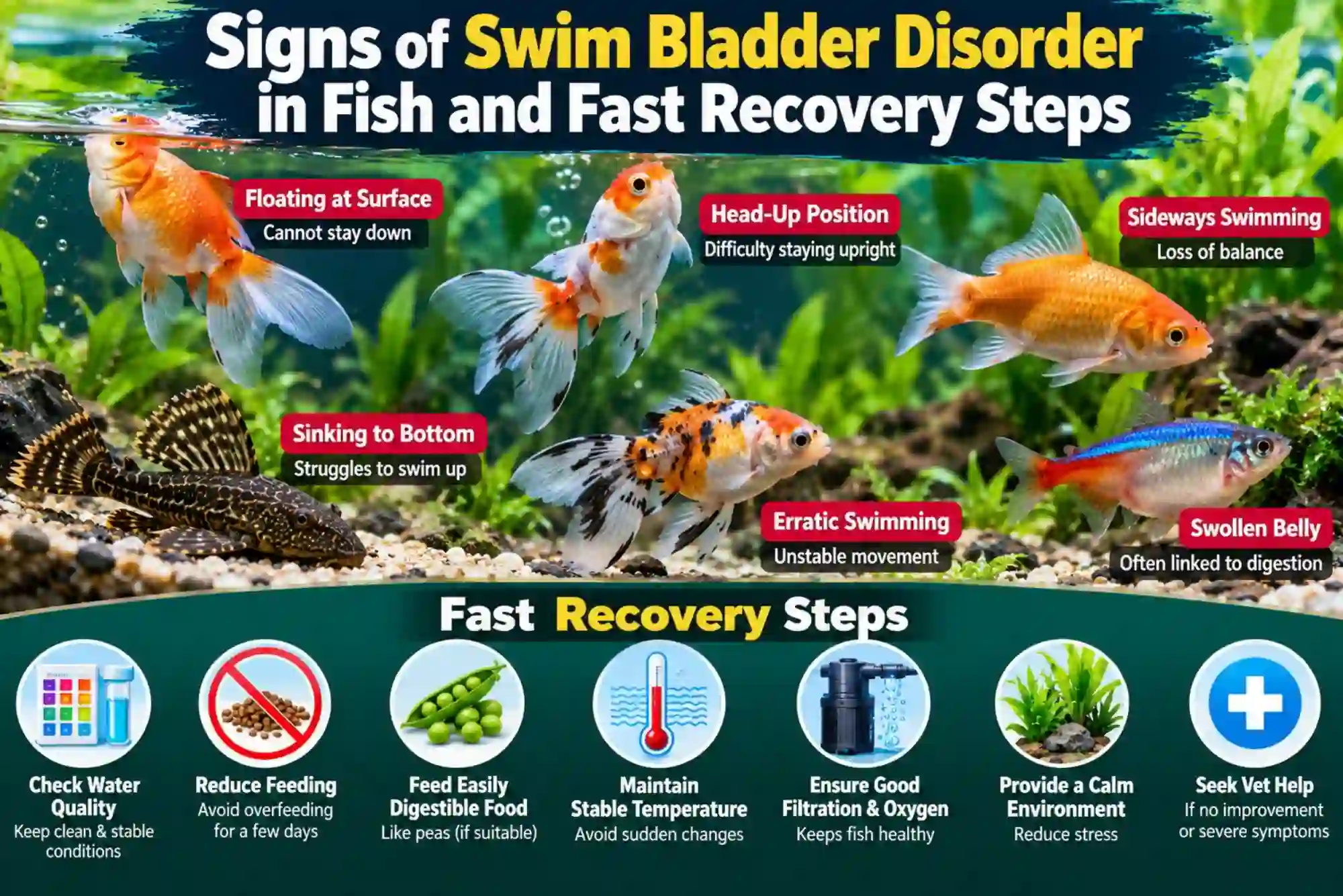
Watching a normally active aquarium fish suddenly float at the surface, sink toward the bottom, swim sideways, or struggle to stay upright can be worrying. One possible explanation is a swim bladder disorder. Because the swim bladder plays an important role in buoyancy and balance, problems affecting it can make even simple swimming difficult.
However, swim bladder disorder is not always a single disease with one specific cause. Buoyancy problems can develop because of digestive issues, poor water quality, inappropriate feeding, injury, infection, internal pressure, developmental abnormalities, or other health conditions. This is why the most effective approach is to look at the fish’s symptoms and the aquarium environment together rather than immediately assuming that the swim bladder itself is damaged.
The good news is that many temporary buoyancy problems can improve when the underlying cause is addressed early. Better water quality, appropriate feeding, reduced stress, and supportive aquarium care can make a significant difference. In more serious cases, however, professional aquatic veterinary care may be necessary.
This guide explains the most common signs of swim bladder disorder in fish, what may cause the problem, what you can do immediately, how feeding affects buoyancy, and how to support a fish during recovery.
The swim bladder is an internal, gas-filled organ found in many bony fish. Its primary function is to help regulate buoyancy, allowing a fish to remain at a particular depth without constantly using its fins to fight gravity.
A healthy fish normally has good control over its position in the water. It can move upward, downward, forward, and backward while maintaining a stable body posture. When buoyancy regulation is disrupted, the fish may have difficulty maintaining its normal position.
The problem can appear in several different ways. Some fish become overly buoyant and repeatedly rise toward the surface. Others become negatively buoyant and struggle to leave the bottom. Some may tilt sideways, swim with their head pointed upward or downward, or roll when attempting to change direction.
Importantly, abnormal swimming does not automatically mean the swim bladder itself is diseased. A fish can develop buoyancy problems because of digestive pressure, weakness, neurological problems, injury, environmental stress, or other internal conditions. Therefore, the term “swim bladder disorder” is often used to describe a noticeable buoyancy problem rather than a single specific illness.
The most obvious sign is a change in the way a fish maintains its position in the aquarium. A healthy fish should generally be able to remain upright and control its depth without excessive effort.
A fish experiencing a buoyancy disorder may repeatedly float toward the surface even when it attempts to swim downward. It may appear to struggle against its own buoyancy and spend much of its time near the top of the aquarium.
Another common sign is sinking. Affected fish may remain close to the substrate and struggle to rise into the water column. Some fish may rest on the bottom more frequently than normal because maintaining their position becomes exhausting.
Sideways swimming is another important warning sign. The fish may lean noticeably to one side, roll slightly, or repeatedly lose its normal upright posture. In more severe cases, the fish may have difficulty controlling its body at all.
You may also notice unusual head or tail positioning. A fish might remain head-up with the tail pointing downward, or the opposite may occur. Swimming in circles, repeatedly drifting in one direction, or struggling to turn normally can also indicate a buoyancy or neurological problem.
Some fish appear to be swimming normally for short periods but lose balance whenever they stop moving. This can be particularly noticeable when the fish tries to rest.
Changes in feeding behavior can accompany the problem. A fish that cannot control its position may struggle to reach floating food, sinking food, or food placed in a particular area of the aquarium. It may remain interested in food but simply be unable to reach it efficiently.
Another sign is increased effort while swimming. A fish may continuously move its fins to remain at a particular depth. This can cause stress and exhaustion over time.
There is no single cause of swim bladder disorder. Understanding the possible causes is important because treatment should target the underlying problem rather than simply trying to “fix” the swim bladder.
One common contributor is digestive disturbance. Overfeeding can cause a fish’s digestive tract to become distended, creating pressure within the abdominal cavity. Constipation and digestive blockage can also affect the fish’s ability to maintain normal buoyancy.
Feeding habits can contribute as well. Some fish swallow excess air while eating floating foods. Dry foods can also expand after becoming wet, depending on the food and feeding method. For certain fish, changing the way food is prepared or delivered may help reduce digestive stress.
Poor aquarium water quality is another major concern. Fish exposed to unsuitable levels of ammonia, nitrite, nitrate, or other water-quality problems can become stressed and more vulnerable to health problems. Water-quality issues may not directly “damage the swim bladder” in every case, but they can contribute to overall illness and make recovery much harder.
Temperature instability can also place additional stress on aquarium fish. Sudden environmental changes can interfere with normal digestion, metabolism, and immune function.
Physical injury is another possibility. A fish may injure itself after colliding with aquarium decorations, being handled improperly, or experiencing aggression from tank mates. Internal trauma can sometimes affect buoyancy or movement.
Infections can also be involved. A bacterial or other internal infection may cause inflammation, weakness, abdominal changes, or other symptoms that result in abnormal swimming.
Some fish have structural or developmental abnormalities that make buoyancy problems more likely. This is particularly relevant to certain selectively bred varieties with unusual body shapes. In these cases, the problem may be long-term rather than something that can be completely corrected.
Internal growths or organ problems can also interfere with normal buoyancy by placing pressure on surrounding structures. These situations generally require professional diagnosis rather than home treatment.
When a fish suddenly develops abnormal swimming behavior, checking the aquarium environment should be one of the first steps.
Test the water using reliable aquarium test equipment and check the parameters appropriate for your fish species. Ammonia and nitrite are particularly important because elevated levels can seriously stress fish. Nitrate should also be monitored as part of routine aquarium maintenance.
Temperature should be checked as well. Make sure it is appropriate for the particular species and stable rather than changing dramatically.
If water quality is poor, correcting the aquarium environment is more important than immediately adding medications. A suitable partial water change with properly conditioned, temperature-appropriate water may be necessary depending on the test results and aquarium conditions.
Filtration should also be inspected. Make sure the filter is operating correctly and that water circulation and oxygenation are appropriate for the aquarium.
For broader aquarium maintenance and algae-management information, the United Fish [Algae Control guide] can also be useful when maintaining a cleaner and more stable aquarium environment.
Avoid making multiple dramatic changes at once. Sudden changes in temperature, pH, or other water conditions can create additional stress. Correct problems carefully and maintain stability.
Before deciding what treatment to use, spend some time observing the affected fish.
Notice whether it is floating, sinking, leaning, rolling, or swimming normally for periods of time. Observe whether the problem started suddenly or developed gradually.
Check whether the fish is eating. A fish that remains alert and interested in food may have a better outlook than one that becomes extremely weak or unresponsive, although appearance alone cannot determine the underlying cause.
Look at the fish’s body for other abnormalities. Swelling, unusual coloration, damaged fins, visible wounds, abnormal scales, rapid breathing, or other changes can provide important clues.
Observe the other fish in the aquarium as well. If several fish suddenly develop unusual swimming behavior at the same time, the problem may be environmental rather than an isolated swim bladder disorder.
Recent changes are also worth considering. Think about whether you recently introduced new fish, changed the food, performed major maintenance, changed the aquarium temperature, rearranged decorations, added treatments, or experienced a filtration problem.
These details can help identify what happened before the symptoms appeared.
If digestive pressure or overfeeding may be contributing to the buoyancy problem, temporarily reducing or withholding food can sometimes give the digestive system time to clear.
The appropriate fasting period depends on the species, age, size, health status, and severity of the problem. Healthy adult fish can generally tolerate a short period without food better than very young, weak, or severely ill fish.
Do not assume that a longer fast is automatically better. The goal is to reduce digestive stress, not to deprive a sick fish unnecessarily.
During this period, continue observing the fish and aquarium conditions. If the fish develops additional symptoms or becomes significantly weaker, the problem may be more serious than a simple digestive issue.
Feeding practices are important when dealing with recurring buoyancy problems.
Avoid giving excessive amounts of food. Many aquarium fish benefit from small portions that they can consume within a short period rather than large meals.
Food should also be appropriate for the species. Different fish have different nutritional requirements, digestive systems, and feeding behaviors.
For fish that struggle with floating foods, sinking or neutrally buoyant food may be easier to manage. The aim is to make feeding easier while reducing unnecessary air intake and digestive stress.
Dry foods can sometimes be softened or prepared according to the manufacturer’s recommendations before feeding. However, this should not replace a balanced diet.
Variety can also be beneficial when appropriate for the species. High-quality prepared foods combined with suitable frozen or fresh foods can help provide balanced nutrition without relying on one food type exclusively.
Avoid repeatedly changing foods during a health problem. Too many dietary changes at once can make it harder to determine what is helping or causing additional digestive stress.
Peas are frequently recommended in aquarium communities for fish experiencing buoyancy problems, especially goldfish. The idea is that their fiber content may help a fish experiencing constipation.
However, peas are not a universal treatment for swim bladder disorder.
If the underlying problem is an infection, injury, structural abnormality, internal disease, or another condition unrelated to constipation, feeding peas will not correct the underlying cause.
For fish species that can safely eat plant matter, a small amount of appropriately prepared food may be used as part of a suitable diet. But species-specific dietary requirements should always come first.
It is also important not to force-feed a fish that is struggling to swim or swallow. Improper handling can increase stress or cause injury.
A recovering fish benefits from a calm and stable environment.
Reduce unnecessary disturbances around the aquarium. Avoid repeatedly catching, chasing, or netting the fish simply to inspect it.
Check that decorations do not have sharp edges or narrow spaces where an unbalanced fish could become trapped.
If the fish is spending a lot of time near the bottom, make sure the environment does not create unnecessary abrasion or injury. If the fish is repeatedly contacting hard surfaces, consider whether the aquarium layout can be made safer.
If the fish is floating near the surface for long periods, monitor whether its body remains exposed to the air. Prolonged exposure can cause secondary irritation or damage, particularly if the fish cannot reposition itself.
The solution should not be to cover the aquarium tightly or reduce oxygen exchange. Good oxygenation remains important, especially when a fish is already stressed.
A separate hospital or quarantine aquarium can sometimes make observation and care easier, particularly if the affected fish is being bullied by tank mates or cannot compete for food.
However, moving a fish is itself stressful. The hospital setup should have appropriate, stable water conditions and safe filtration.
A poorly prepared hospital tank can create more problems than it solves. Never move a sick fish into completely different water conditions without considering the stress caused by sudden changes.
If the main aquarium has excellent water quality and peaceful tank mates, isolation may not always be necessary. The decision should depend on the fish’s condition, tank dynamics, and suspected cause.
One of the biggest mistakes aquarium owners can make is treating every buoyancy problem as an infection.
Not every fish that floats or sinks has a bacterial infection. Using medications without identifying the likely cause can expose the fish to unnecessary stress and may affect the aquarium’s biological filtration.
Medications should be selected according to the suspected condition and the fish species. If an infection is suspected because the fish has additional signs of illness, professional aquatic veterinary guidance is preferable.
Similarly, avoid improvised procedures intended to physically manipulate the abdomen or swim bladder. Attempting to puncture, squeeze, or otherwise physically alter the fish can cause severe injury.
A buoyancy disorder should be approached as a health problem that needs diagnosis rather than as a simple mechanical issue.
Some symptoms suggest that the problem may be more serious than a mild digestive disturbance.
If the fish is extremely weak, breathing rapidly, unable to remain upright, showing obvious wounds, developing severe swelling, or refusing food for an extended period, additional evaluation may be necessary.
The situation is particularly concerning if multiple fish become sick at the same time. This may indicate a water-quality problem, toxin exposure, oxygen issue, temperature problem, or another aquarium-wide condition.
Rapid deterioration should also be taken seriously.
A fish that has had mild buoyancy problems for a short time may improve with environmental and feeding adjustments. A fish whose condition is progressively worsening needs a different level of attention.
When possible, consult a veterinarian experienced with fish or aquatic animals when symptoms persist, become severe, or occur alongside other signs of illness.
Recovery time depends entirely on the cause.
A mild digestive problem may improve relatively quickly after feeding practices and water quality are corrected. Other cases may take considerably longer.
If the underlying cause is environmental, improvement may begin after the aquarium conditions are stabilized. If infection, injury, or internal disease is involved, recovery may require more specialized treatment.
Structural or congenital buoyancy problems may not be completely reversible. Some fish can nevertheless live comfortably for a long time with permanent swimming limitations when their environment and feeding routine are adapted to their needs.
The most important thing is to judge progress based on the fish’s overall condition rather than expecting an exact recovery timeline.
A fish that gradually becomes more active, maintains its position more effectively, eats normally, and shows fewer abnormal swimming episodes is generally showing encouraging progress.
A fish with a severe buoyancy problem may have difficulty reaching food. In a community aquarium, healthier fish may consume the available food before the affected fish can reach it.
In this situation, feeding may need to be adjusted so the affected fish can access food more easily.
Food can sometimes be delivered closer to the fish rather than scattered throughout the aquarium. The goal is to allow the fish to eat without forcing it to compete with faster tank mates.
Avoid grabbing the fish simply to hand-feed it. Physical handling can increase stress and potentially damage the protective mucus layer.
If the fish spends most of its time at the bottom, make sure food reaches an accessible location. If it remains near the surface, consider food that can be safely consumed at that level without encouraging excessive air intake.
The feeding strategy should be adapted to the fish’s specific condition.
Prevention begins with consistent aquarium care.
Maintain stable water conditions and perform routine testing appropriate for the aquarium. Regular maintenance helps identify problems before they become severe.
Feed appropriate portions rather than allowing fish to consume excessive amounts. Overfeeding is one of the most common aquarium-management mistakes and can contribute to poor water quality as well as digestive problems.
Choose foods appropriate for the species and avoid relying entirely on one unsuitable food type.
Keep the aquarium appropriately stocked. Overcrowding increases waste production and can make water-quality management more difficult.
Maintain effective filtration and adequate oxygenation. Equipment should be checked regularly so failures are identified quickly.
Avoid sudden environmental changes whenever possible. Fish generally respond better to stable conditions than to frequent dramatic fluctuations.
Tank mates should also be selected carefully. Aggressive fish can cause chronic stress or physical injuries that may contribute to health problems.
Aquarium decorations should be safe, stable, and appropriate for the fish’s swimming behavior.
Goldfish are among the aquarium fish most commonly associated with buoyancy problems, especially fancy varieties with compact or rounded body shapes.
A fancy goldfish may develop difficulty maintaining its normal swimming position because of digestive problems, environmental stress, anatomical factors, or other health conditions.
It is important not to assume that every floating goldfish has the same problem. One fish may have a temporary digestive issue, while another may have a structural condition or internal disease.
Goldfish also produce significant waste, making water quality particularly important. Poor aquarium maintenance can contribute to stress and illness, which may make buoyancy problems worse.
For goldfish, balanced feeding, appropriate portions, stable water conditions, and careful observation are especially important.
Betta fish can also experience buoyancy problems. Their symptoms may include floating, sinking, tilted swimming, or difficulty maintaining position.
Because bettas are often kept in relatively small aquariums, water-quality changes can sometimes occur quickly if maintenance is inadequate.
A betta that suddenly develops buoyancy problems should therefore be evaluated in the context of water quality, feeding, temperature, stress, and other symptoms.
Avoid assuming that constipation is automatically the cause. If the fish shows additional symptoms or fails to improve after basic environmental corrections, further investigation is appropriate.
Sometimes, but not always.
If the underlying cause is temporary and reversible, a fish may return to normal swimming after the problem is corrected.
For example, a fish experiencing a short-term digestive disturbance may regain normal buoyancy after its feeding routine and digestive health improve.
Other cases may be more complicated. An injury, infection, internal disease, or developmental abnormality may produce long-lasting changes.
A permanent buoyancy disorder does not necessarily mean that the fish cannot have a good quality of life. Some fish adapt surprisingly well when their aquarium environment is adjusted to make swimming, resting, and feeding easier.
The objective should therefore be to identify and correct reversible problems while providing appropriate long-term support when a permanent condition is present.
One common mistake is assuming that every fish floating at the surface has a damaged swim bladder. Buoyancy problems have many possible causes, and the symptoms alone cannot always identify the exact one.
Another mistake is immediately adding medication. Medication should not be used as a substitute for water testing, observation, and diagnosis.
Overfeeding during recovery is also a problem. A worried owner may continue offering food because the fish appears weak, but excessive feeding can worsen digestive problems.
Sudden temperature or water-chemistry changes should also be avoided. Attempting to “fix” the aquarium too quickly can create additional stress.
Physical manipulation of the fish should never be attempted as a home remedy.
Finally, do not ignore recurring symptoms. If a fish repeatedly develops buoyancy problems, the underlying issue deserves investigation rather than repeated short-term fixes.
When a fish suddenly develops signs of swim bladder disorder, begin by observing the swimming pattern and checking the aquarium environment.
Test the water and correct any confirmed problems carefully. Check temperature, filtration, oxygenation, and recent maintenance history.
Consider whether the fish has been overfed or recently received a different type of food. If a digestive problem is suspected, a temporary reduction in feeding may be appropriate for a healthy adult fish, followed by small portions of suitable food.
Keep the aquarium calm and prevent the fish from injuring itself against decorations or the substrate.
Monitor appetite, activity, breathing, body position, and overall appearance over the following days.
If the condition improves, continue stable aquarium management rather than immediately returning to heavy feeding or making unnecessary changes.
If the fish becomes weaker, develops additional symptoms, stops eating, or fails to improve, seek advice from a veterinarian experienced with fish.
Swim bladder disorder can look frightening, but abnormal swimming does not always mean that a fish has permanent damage to its swim bladder. Floating, sinking, sideways swimming, head-up posture, tail-down posture, rolling, and difficulty maintaining depth are signs that something is affecting the fish’s buoyancy or ability to control its body.
The first response should be careful observation and attention to the aquarium environment. Check water quality, review feeding habits, maintain stable conditions, reduce stress, and protect the fish from injury.
Digestive problems can sometimes improve with appropriate feeding adjustments, while more complicated cases may require professional diagnosis and treatment.
The most important principle is to treat the cause rather than simply treating the symptom. A healthy aquarium environment, suitable nutrition, stable water conditions, and early attention to unusual behavior can give an affected fish the best chance of recovery.
For more aquarium information and fish-care resources, visit the [United Fish homepage].
A swim bladder problem should never be treated as a guaranteed diagnosis based only on floating or sinking. If symptoms are severe, persistent, worsening, or accompanied by other signs of illness, professional aquatic veterinary advice is the safest option. With careful observation and appropriate aquarium care, many fish with temporary buoyancy problems can recover and return to more normal swimming behavior.