
Every business wants its operations to remain efficient, productive, and uninterrupted. However, maintaining business equipment, facilities, and essential systems requires regular attention. Without proper maintenance, even reliable equipment can eventually develop faults that affect daily operations.
Unexpected breakdowns can create several challenges for businesses. They may result in emergency repair expenses, operational delays, reduced productivity, and inconvenience for employees and customers. This is why many organizations choose a structured maintenance strategy through an Annual Maintenance Contract (AMC).
An AMC provides businesses with access to scheduled maintenance and professional technical support throughout an agreed contract period. Rather than waiting for equipment to fail, companies can take a proactive approach to maintaining their assets.
An annual maintenance contract is a service agreement between a business and a professional maintenance provider. The agreement normally remains active for one year and defines the equipment, systems, or facilities that will receive maintenance.
Depending on the contract, services may include routine inspections, preventive maintenance, cleaning, testing, troubleshooting, minor repairs, and technical support.
The exact services vary depending on the provider and the type of equipment being maintained. Some contracts may also include emergency support, while major repairs and replacement parts may be billed separately.
For this reason, businesses should understand the complete scope of an AMC before signing an agreement.
Business equipment operates continuously in many commercial environments. Air conditioning systems, electrical installations, machinery, plumbing systems, generators, and other facilities can experience normal wear and tear.
If these systems are not inspected and serviced regularly, small problems can become larger issues.
Regular maintenance provides an opportunity to identify potential faults before they cause serious disruption. It also allows businesses to maintain equipment according to recommended service schedules.
An organized maintenance strategy can therefore contribute to greater reliability and better asset management.
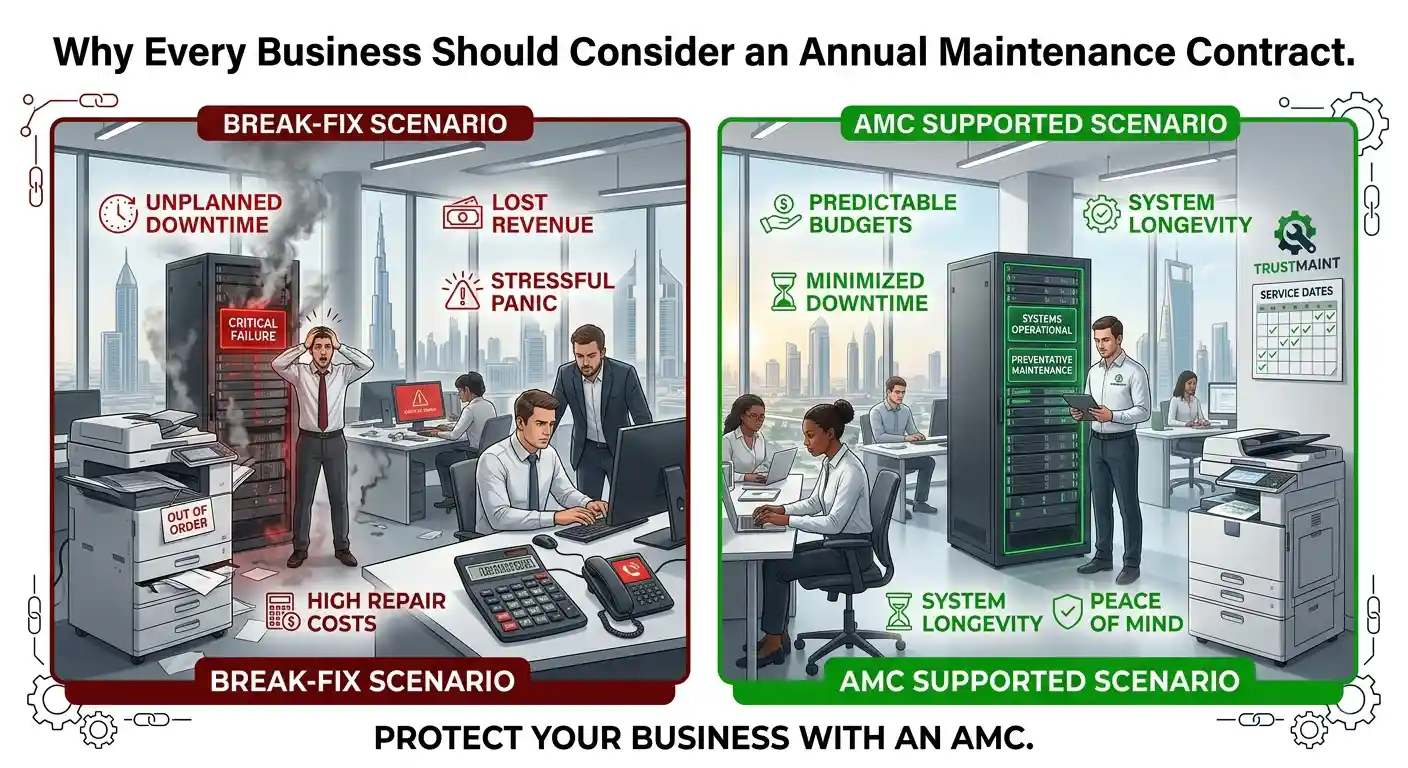
Unexpected equipment failures can disrupt normal business operations.
For example, a malfunctioning cooling system can affect an office or retail environment, while a problem with essential machinery can interrupt production. Electrical or plumbing issues can also create significant inconvenience in commercial buildings.
An AMC supports preventive maintenance by allowing technicians to inspect equipment regularly.
When potential problems are discovered early, businesses may have an opportunity to repair them before they develop into major failures.
Emergency maintenance can sometimes be more expensive than planned servicing. Businesses may need to pay additional charges for urgent visits, replacement components, or major repairs.
An annual maintenance contract can make maintenance expenses more predictable by establishing agreed service costs for the contract period.
Although an AMC does not necessarily cover every possible repair, regular maintenance can help reduce avoidable expenses associated with neglected equipment.
Businesses can also plan their maintenance budgets more effectively when they know the expected contract costs in advance.
Well-maintained equipment is generally better positioned to deliver consistent performance.
During scheduled maintenance visits, technicians can inspect components, clean systems, identify faults, and make necessary adjustments.
These activities can help address performance issues before they become more serious.
For businesses that depend on equipment every day, maintaining consistent performance can be important for productivity and operational efficiency.
Replacing commercial equipment can require a substantial investment. Businesses naturally want their assets to remain useful for as long as reasonably possible.
Regular maintenance can help protect equipment from excessive wear and damage.
Technicians can identify components that require attention and recommend repairs or servicing before a minor issue causes more extensive damage.
An AMC can therefore support better long-term asset management and potentially delay unnecessary equipment replacement.
Downtime can affect more than equipment. It can impact employees, customers, production schedules, and business revenue.
While maintenance cannot completely eliminate the possibility of equipment failure, preventive servicing can reduce the risk of unexpected problems.
A maintenance provider working under an AMC can also provide technical assistance when an issue occurs, depending on the contract terms.
Having an established service relationship can make it easier for businesses to respond quickly to maintenance problems.
Managing maintenance internally can become complicated when a business operates multiple systems or locations.
Managers may have to schedule inspections, contact technicians, maintain service records, monitor repairs, and follow up on recurring problems.
An annual maintenance contract can simplify this process by giving the business a dedicated maintenance provider.
The provider can handle scheduled visits and technical support according to the agreed maintenance plan, allowing business managers to focus on other responsibilities.
Maintenance is closely connected to workplace safety.
Poorly maintained electrical systems, damaged machinery, faulty equipment, leaks, or other facility problems can create potential hazards.
Regular inspections allow technicians to identify maintenance issues that may affect employees, customers, or visitors.
A professional AMC can support a safer working environment by encouraging businesses to address maintenance problems consistently rather than ignoring them until they become serious.
An AMC can make maintenance more predictable.
Businesses can schedule routine servicing around their operational requirements and prepare for planned maintenance activities.
Instead of dealing with maintenance problems only when they occur, managers can use maintenance records and service reports to understand equipment condition and plan future expenses.
This can make long-term facility and asset management more organized.
Businesses may not always have in-house technicians with the expertise required to maintain every type of equipment.
A professional maintenance company can provide access to trained technicians who understand specific systems and maintenance procedures.
This can be particularly useful for businesses with complex equipment or specialized facility requirements.
Professional technicians can also provide recommendations when they identify recurring problems or equipment approaching the end of its useful life.
The coverage of an annual maintenance contract depends on the provider and the customer’s requirements.
Common areas may include air conditioning systems, electrical systems, plumbing, generators, building equipment, machinery, and other essential facilities.
Services can include scheduled inspections, preventive servicing, cleaning, testing, troubleshooting, and minor repairs.
Some contracts provide broader coverage, while others are designed for specific equipment or systems.
Businesses should always request a detailed service list before signing the agreement.
Choosing the right provider is essential for getting value from an AMC.
Businesses should consider the company’s experience, technical capabilities, availability, service response time, reputation, and experience with similar equipment.
It is also important to compare the terms offered by different providers.
Rather than selecting the cheapest option, businesses should consider the overall value of the service. A provider offering better technical support and broader coverage may provide greater long-term value.
Before signing an AMC, businesses should carefully review the contract.
The agreement should clearly explain the maintenance schedule, equipment covered, services included, response times, emergency support, payment terms, exclusions, and renewal conditions.
Customers should also determine whether spare parts and major repairs are included or charged separately.
Understanding these details in advance can help businesses avoid unexpected costs and establish clear expectations.
For many businesses, an AMC can be a valuable maintenance solution, particularly when equipment reliability is important to daily operations.
The benefits depend on factors such as the type of equipment, frequency of use, property size, maintenance requirements, and potential cost of downtime.
A business that relies heavily on essential equipment may find that planned maintenance provides significant value by reducing operational risks and simplifying maintenance management.
Every business has different maintenance requirements, but reliable equipment and facilities are essential for maintaining smooth operations. An Annual Maintenance Contract provides a structured way to manage these requirements through scheduled inspections, preventive maintenance, and professional technical support.
From reducing unexpected breakdowns and controlling maintenance expenses to improving equipment performance and supporting workplace safety, an AMC can provide several practical benefits.
The key is to choose a reliable provider and carefully review the contract before signing. When the agreement matches the business’s actual requirements, an annual maintenance contract can become an effective part of long-term maintenance and asset management.
Related Reading: What Movers Are Not Allowed To Transport in the UAE
Related Reading: Methylstenbolone et ses Applications Sportives — full guide
Related Reading: TEREA Tobacco vs Menthol in Dubai: Which Flavor Profile Should You Choose? — full guide
Related Reading: How to Choose a Reliable Carrier AC Supplier for Your Property
Related Reading: Why Should You Consider an Apartment for Sale in Al Furjan Today?
Related Reading: Auto Care in the UAE: From Car Detailing to Regular Maintenance
Related Reading: The Art and Craft of Fishing Lures: Elevating Every Angling Experience